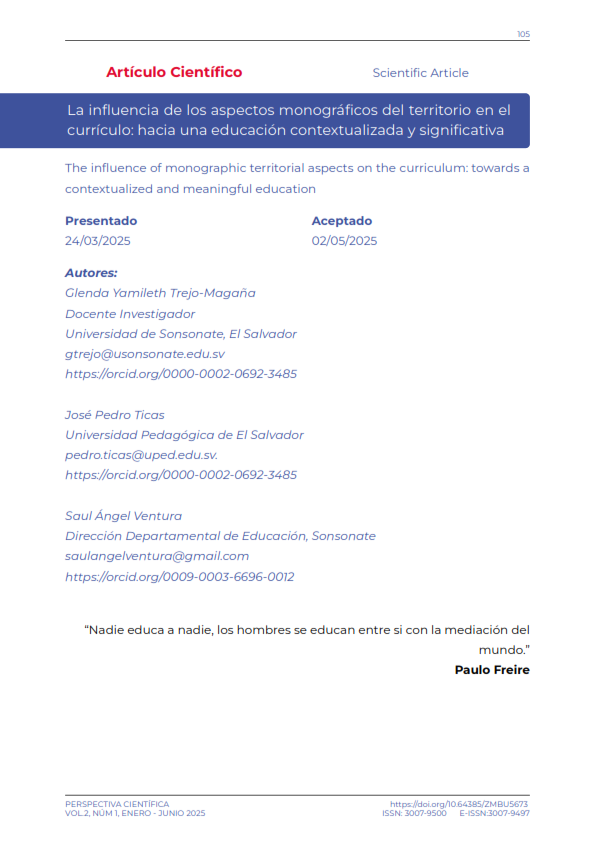
La influencia de los aspectos monográficos del territorio en el currículo:
hacia una educación contextualizada y significativa
Palabras clave:
Currículo contextualizado, Territorio, Justicia social, Educación transformadoraResumen
La presente investigación analiza la influencia de los aspectos monográficos del territorio en el currículo educativo, destacando cómo las características geográficas, económicas, culturales y sociales moldean la relevancia y pertinencia de los programas educativos. Realizada en el departamento de Sonsonate, El Salvador, con una muestra de 1019 estudiantes de educación media, se utilizó un diseño descriptivo y un cuestionario estructurado de 22 ítems para explorar variables clave como el entorno geográfico, los recursos naturales, las prácticas culturales y la configuración social. Los resultados reflejan que el 58.9% de los estudiantes residen en zonas rurales, en contraste con la tendencia nacional de concentración urbana, lo que evidencia la especificidad del contexto local en el diseño curricular. El análisis crítico sugiere que el currículo debe adaptar se para integrar estas particularidades territoriales, fomentando aprendizajes significativos y sostenibles. Destaca la dependencia de recursos hídricos como los ríos (50%) y la preeminencia de actividades económicas agrícolas (41,7%), aspectos que subrayan la relación dialéctica entre territorio y educación. Sin embargo, también se identifican brechas significativas, como la limitada infraestructura cultural y el acceso desigual a servicios básicos, lo que plantea desafíos para la justicia social y la equidad educativa. Esta investigación reafirma la necesidad de un currículo contextualizado que articule las dinámicas territoriales con objetivos educativos, promoviendo una educación transformadora que responda a las realidades locales. En este marco, se propone avanzar hacia políticas educativas que prioricen la interacción escuela-comunidad-territorio como elemento clave para la cohesión social y el desarrollo integral.Resumen
126
126
PDF 75
HTML 29
EPUB 93
HTML 29
EPUB 93
Publicado
2025-08-27
Cómo citar
Trejo-Magaña, G. Y., Ticas, J. P., & Ventura, S. Ángel. (2025). La influencia de los aspectos monográficos del territorio en el currículo:: hacia una educación contextualizada y significativa. Perspectiva Científica, 2(1), 105-135. https://doi.org/10.64385/ZMBU5673
Número
Sección
Artículos
Licencia

Esta obra está bajo una licencia internacional Creative Commons Atribución-NoComercial-CompartirIgual 4.0.
Usted es libre de:
- Compartir — copiar y redistribuir el material en cualquier medio o formato
- Adaptar — remezclar, transformar y construir a partir del material
- La licenciante no puede revocar estas libertades en tanto usted siga los términos de la licencia
Bajo los siguientes términos:
- Atribución — Usted debe dar crédito de manera adecuada , brindar un enlace a la licencia, e indicar si se han realizado cambios . Puede hacerlo en cualquier forma razonable, pero no de forma tal que sugiera que usted o su uso tienen el apoyo de la licenciante.
- No Comercial — Usted no puede hacer uso del material con propósitos comerciales .
- Compartir Igual — Si remezcla, transforma o crea a partir del material, debe distribuir su contribución bajo la la misma licencia del original.
No hay restricciones adicionales — No puede aplicar términos legales ni medidas tecnológicas que restrinjan legalmente a otras a hacer cualquier uso permitido por la licencia.
Cómo citar
Trejo-Magaña, G. Y., Ticas, J. P., & Ventura, S. Ángel. (2025). La influencia de los aspectos monográficos del territorio en el currículo:: hacia una educación contextualizada y significativa. Perspectiva Científica, 2(1), 105-135. https://doi.org/10.64385/ZMBU5673


