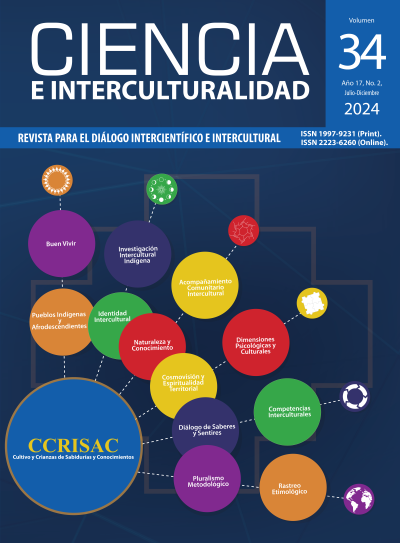
Perspectives and Paths for Nurturing, Planting Wisdom and Knowledge - CRISSAC in the Polindara Indigenous People, Cauca, Colombia
DOI:
https://doi.org/10.5377/rci.v34i2.20520Keywords:
urturing, planting of wisdom and knowledge, decolonizing Indigenous methodology, cosmovision and territorial spirituality, dialogue of knowledge and living, pedagogy of oral memory, Polindara PeopleAbstract
The article emerges from a journey to dialogue about indigenous methodologies, focusing on the connection between research and communities. It underlines the need to decolonize methodologies, embracing the context and ethical implications of research for communities. It highlights the pedagogy of oral memory, territorial journey, community assembly, dialogue of knowledge and living, the reconceptualization of history as essential methods in this approach. The nurturing and planting of wisdom and knowledge - CRISSAC is positioned in contrast to colonial paradigms, aiming for an urgent decolonization of research as a political and epistemological tool for the social, cultural and identity strengthening of peoples.
This article is more than a pedagogical exploration; it is a vibrant testimony of the resilience, depth and vitality of the CRISSAC paths or indigenous research methods with their community, spiritual, territorial and experiential approach of Indigenous Peoples such as Poliandra in Cauca and an intercultural recognition of Afro-descendants and peasants. It invites us to recognize and value these methodologies as guardians of the history, culture and legacy of Indigenous Peoples, not only as contributions to academia, but as fundamental pillars such as the cultivation of wisdom for the preservation and flourishing of their communities and Life Plans.
Downloads
591
HTML (Español (España)) 56
Resumen.mp3 (Español (España)) 142
Abstract.mp3 (Español (España)) 122
Downloads
Published
How to Cite
Issue
Section
License
Copyright (c) 2024 URACCAN

This work is licensed under a Creative Commons Attribution-NonCommercial-NoDerivatives 4.0 International License.
Copyright © (URACCAN)

This journal is licensed under a Creative Commons Attribution-NonCommercial-NoDerivatives 4.0 International License.
This license allows others to download the works and share them with others, as long as their authorship is acknowledged, but they can not be changed in any way nor can they be used commercially.


