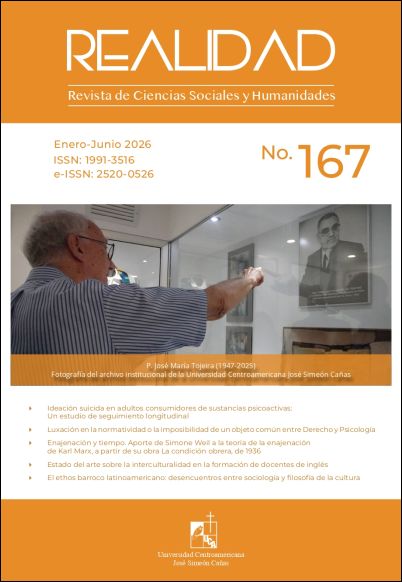
Alienation and Time. Simone Weil’s Contribution to Karl Marx’sTheory of Alienation, Based on her 1936 work, The Laborer Condition
Keywords:
Alienation, Time, Rhythm, Industrial plants, CapitalismAbstract
This article analyzes how Karl Marx’s concept of “alienation”, developed in The Economic and Philosophical Manuscripts of 1844 to explain the worker’s alienation under capitalism, is enriched by Simone Weil’s phenomenological reflection in her 1936 work, «The Laborer Condition. While Marx approaches alienation from a structural critique of the production system, Weil delves into the concrete life experience of the worker, introducing «time» as a key factor in understanding their dehumanization.
Marx explains alienation as a phenomenon derived from private property and the división of labor, focusing his conclusions on material effects. However, Weil points out that his analysis overlooks experiential dimensions such as the monotony of industrial time, the fragmentation of attention, and the loss of psychological agency in repetitive gestures, which give the worker the feeling of having no control over what they do or think, making alienation not only economic but also existential, where mechanized time drains the worker’s life of meaning.
Weil’s contribution lies in demonstrating that Marx, in prioritizing an abstract critique of the capitalist production system, overlooked how factory temporality corrodes human subjectivity. Her phenomenological reading reveals that capitalist alienation cannot be overcomed solely through structural changes, but by transforming the qualitative relationship between human beings and their labor and time.
Downloads
318
EPUB (Español (España)) 52
References
Dolby Múgica, M. C. (2002). Simone Weil y la crítica al marxismo a través de su concepción del trabajo. Espíritu: cuadernos del Instituto Filosófico de Balmesiana, (25), 79-92. https://dialnet.unirioja.es/descarga/articulo/5522335.pdf
Estrada López, M. (2014). La enajenación del trabajo en los Manuscritos económico-filosóficos de 1844, de Karl Marx. Collectivus, Revista de Ciencias Sociales, 1(1), 109-127. https://www.researchgate.net/publication/302139171_LA_ENAJENACION_DEL_TRABAJO_EN_LOS_MANUSCRITOS_ECONOMICO-FILOSOFICOS_DE_1844_DE_KARL_MARX
Fiori, G. (1989). Simone Weil An Intellectual biography. University of Georgia Press.
Fromm, E. (2004). Marx y su concepto del hombre. Fondo de Cultura Económica.
Granados Valdéz, J. (2022). Breve apunte sobre la crítica a Marx y los marxistas de Simone Weil. El Cuaderno Digital. https://elcuadernodigital.com/2022/04/04/breve-apunte-sobre-la-critica-a-marx-y-los-marxistas-de-simone-weil/
Marx, K. (1987). Los manuscritos de 1844. UCA Editores.
Marx, K. y Engels, F. (1974). La ideología alemana. Ediciones Pueblos Unidos y Ediciones Grijalbo.
Matheu Ribera, P. y Pérez-Fernández, A. (2022). La crítica de Simone Weil a Marx: un referente para el pensamiento ecosocialista. Isegoría, (66), e27. https://doi.org/10.3989/isegoria.2022.66.27
Panichas, G. A. (1984). Simone Weil: A Modern Pilgrim. Oxford University Press.
Pétrement, S. (1976). Simone Weil – A Life. Pantheon Books.
Ruiz Jiménez, J. M. (2017). Proteo y la desapropiación del tiempo en Simone Weil. Trans/Form/Ação, 40(3), 113-132. https://doi.org/10.1590/S0101-31732017000300007
Ruiz Jiménez, J. M. (2019). Impotencia y tiempo en los escritos de juventud de Simone Weil. Revista de Filosofía Aurora, 31(52), 347-366. https://doi.org/10.7213/1980.5934.31.052.A003
Weil, S. (1994). La gravedad y la gracia. Trotta.
Weil, S. (1995). Reflexiones sobre las causas de la libertad y la opresión social. Editorial Anthropos.
Weil, S. (1996). A la espera de Dios. Trotta.
Weil, S. (2010). La condición obrera. El Cuenco de Plata.
Published
How to Cite
Issue
Section
License

This work is licensed under a Creative Commons Attribution-NonCommercial 4.0 International License.
© Realidad: Revista de Ciencias Sociales y Humanidades
Authors who publish in this journal accept the following conditions:
Realidad: Revista de Ciencias Sociales y Humanidades, provides open and immediate access to its content, based on the Open Access Policy of the Central American University "José Simeón Cañas"provides open and immediate access to its content.
According to the copyright legislation, Revista de Ciencias Sociales y Humanidades Journal published by the Universidad Centroamericana José Simeón Cañas, recognizes and respects the moral rights of the authors, as well as the ownership of the patrimonial right, which will be assigned to the journal for its diffusion in open access, in printed version and in digital format. By being part of multiple indexers, databases and reference systems, the articles published by Revista de Ciencias Sociales y Humanidades will be visible and available for downloading on these websites, indicating, in all cases, the authorship of the articles, the date of publication and the number of the journal to which they correspond.
You are free to:
- Share: copy and redistribute the material in any medium or format
- Adapt: remix, transform, and build upon the material
Under the following terms:
- Attribution: You must give appropriate credit, provide a link to the license, and indicate if changes were made. You may do so in any reasonable manner, but not in any way that suggests the licensor endorses you or your use.
- Non-Commercial: You may not use the material for commercial purposes.


