“LIKE” SELECTIVE VIOLENCE
Analysis of gang discourse through readers' comments on Facebook of salvadorans digital newspapers
DOI:
https://doi.org/10.5377/aai.v1i9.21090Keywords:
Content analysis (Communication), Communication-Research, Information technology, Online social networks-InfluenceAbstract
Social networks have made it easier for citizens with access to new technologies to express themselves and confront their political leaders. This topic, in El Salvador, points to the violence generated by gangs. This text analyzes the discourse of citizens on this problem. It is a discourse that shows the desire of the majority of Internet users to end violence through more violence, which they justify and even rejoice in, as long as the one who suffers it is the marero. A narrative that is also consistent with the journalistic accounts, which have incited fear, encouraged military repression as a solution and established the gangs as the only enemy of society.
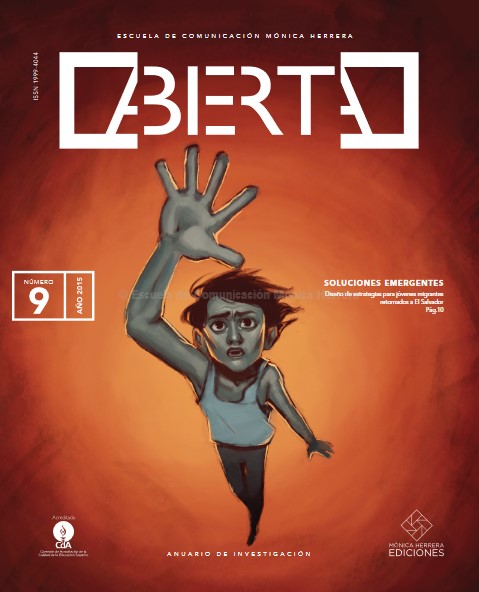
ECMH ABIERTA_II_N9- 2015-15-29.
103
HTML (Español (España)) 24
References
Aguilar, J. (2006). Los resultados contraproducentes de las políticas antipandillas. ECA, 62(708): 877-890.
Berlanga, I, García-García, F. y Victoria, J. (2013). Ethos, pathos y logos en Facebook. El usuario de redes: nuevo «rétor» del siglo XXI. Comunicar, nº 41, v. XXI, 2013, Revista Científica de Educomunicación; páginas 127-135
Carballo, W. (2015). The truce and everyday life in a violence free municipality: The case of Santa Tecla in El Salvador.
Bielefeld: International Center for Violence Research – ICVR:
Carballo, W. y Pérez, R. (2013). El mapa de medios en El Salvador. En Fundación Comunicándonos (2013), Comunicación, información y poder en El Salvador. San Salvador: Fundación Comunicándonos.II 28
Ching, E.; Lindo, H y Lara, R. (2010). Recordando 1932: la matanza, Roque Dalton y la política de la memoria histórica. San Salvador: FLACSO.
Cruz, J. M. (2005). Los factores asociados a las pandillas juveniles en Centroamérica. Estudios Centroamericanos (ECA), 685(686): 1155-1182.
Dudley, S. y Pachico, E. (2013). El Salvador’s Gang Truce: Positives and Negatives. INSIGHT: Estados Unidos. Visita 27 de junio de 2015 en http://www.offnews.info/
El Diario de Hoy (2015) 2015: el peor año para la Policía desde su fundación, 58 policías muertos. Visita 14 de enero de
El Faro (2012). Gobierno negoció con pandillas reducción de homicidios. Visita 20 de junio de 2015 en
http://www.elfaro.net/es/201203/noticias/7985/
El Faro (2015). Gobierno propone becas y créditos para pandilleros que se retiren. Visita 27 de junio de 2015 en
eros-que-se-retiren.htm
Galindo, J. (2013). Las nuevas tecnologías de la información, comunicación y las políticas culturales en México, en Islas.
Glaser, B. y Strauss, A. (1967). The discovery of grounded theory: strategies for qualitative research. New York: Aldine
de Gruyter.
Hernández, M. (2015). Salvadoran gangs: Political Actors in the Making? International Center for Violence Research – ICVR, Alemania: Bielefeld.
LPG Datos (2014). La delincuencia es lo que más preocupa.
Visita 30 de junio de 2015 en http://www.laprensagrafica.com/2014/01/17/la-delincuencia-es-lo-que-mas-preocupa
Marroquín, A. y Vásquez, O. (2014). Entre gritos y silencios. La narrativa de la prensa salvadoreña sobre la tregua entre
pandillas. Revista Nueva Sociedad, N.o 249, Enero-Febrero.
Marroquín, A. (2007). Indiferencias y espantos. Relatos de los jóvenes de pandillas en la prensa escrita de
Centroamérica. En Rey, German. Los relatos periodísticos del crimen, Bogotá: Centro de Competencia en Comunicación.
Martel, R. (2007). Las maras: nuevas formas de espanto y control social. En Valenzuela, J., Nateras, Alfredo y
Reguillo, R. Las maras: identidades juveniles al límite. México: Universidad Autónoma Metropolitana.
Octavio y Paola Ricaurte (2013). Investigar las redes sociales. México: Razón y Palabra.
Ricaurte, P. (2013). Redes ciudadanas en la era digital: la nueva esfera pública, en Islas, Octavia y Paola Ricaurte, Investigar las redes sociales
Rodgers, D. (1999). Youth Gangs and Violence in Latin America and the Caribbean: A Literature Survey. Washington: The World Bank.
Santacruz, M. y Cruz, J. M. (2001). Las maras en El Salvador. En ERIC IDESO, IDIES e IUDOP (comp.) Maras y pandillas
en Centroamérica, Vol. 1. Managua: UCA Publicaciones.Tager, A. y Aguilar, I. (2013). La tregua entre pandillas
salvadoreñas, hacia un proceso de construcción de paz social. Guatemala: Interpeace.
https://www.facebook.com/elsalvadorcom/posts/905537162816191:0. Última visita: 23 de junio de 2015.
https://www.facebook.com/lpg.laprensagrafica/posts/956301107745431. Última visita: 23 de junio de 2015.
https://www.facebook.com/lapaginasv/posts/865861850117520. Última visita: 15 de junio de 2015.
https://www.facebook.com/elblogsv/posts/952469474796317. Última visita: 15 de junio de 2015.
Published
How to Cite
Issue
Section
License
Copyright (c) 2015 Willian Carballo

This work is licensed under a Creative Commons Attribution-NonCommercial-ShareAlike 4.0 International License.
You are free to:
- Share — copy and redistribute the material in any medium or format
- Adapt — remix, transform, and build upon the material
- The licensor cannot revoke these freedoms as long as you follow the license terms.
Under the following terms:
- Attribution — You must give appropriate credit , provide a link to the license, and indicate if changes were made . You may do so in any reasonable manner, but not in any way that suggests the licensor endorses you or your use.
- NonCommercial — You may not use the material for commercial purposes .
- ShareAlike — If you remix, transform, or build upon the material, you must distribute your contributions under the same license as the original.
- No additional restrictions — You may not apply legal terms or technological measures that legally restrict others from doing anything the license permits.
Notices:
You do not have to comply with the license for elements of the material in the public domain or where your use is permitted by an applicable exception or limitation .
No warranties are given. The license may not give you all of the permissions necessary for your intended use. For example, other rights such as publicity, privacy, or moral rights may limit how you use the material.


