Established in 2011 and hosted by Ubiquity.
Managed by Mongolian Academy of Sciences.
This website supports the online publication of Mongolian journals. For more information about MongoliaJOL and how to join the service see the About page.
Guidelines for publication and evaluation of articles
Conocimiento Educativo establishes the following guidelines for the presentation of the different research articles, in order to be published within it:
1. Extension of articles
Articles must not exceed the limit of 2,000 words, nor have less than 3,500 in the format established by the journal.
2. Presentation format of articles
The articles must be submitted in MS Word format, in the Palatino Linotype typeface, font 11, at a space of 1.5 between lines and 6 points between paragraphs; text to a single column with justified alignment. The margins of each page should be 2.5 cm. superior, right and inferior; and the left one of 3 cm.
3. Presentation of graphics, tables, figures and images
The images and figures should be presented in .TIF or .JPG format in high resolution (300 dpi or greater than 900px), inserted in the text. In the same way the original images must be sent in a separate folder, with the editable files of the programs in which they were worked (Photoshop or Illustrator compatible from the CS3 version and later).
The graphics and tables will be included before the text you allude to and will be made in Excel 2000 or higher, inserted in the document as spreadsheets and not as images.
Each of these elements must be numbered in a progressive manner and necessarily have a title, as well as a foot that specifies the source of origin.
Each article should include, if applicable, graphs, tables, figures and images that reflect statistics and visually the data. Failing this, if the author and / or authors do not consider these elements necessary for the presentation of their article, they may omit them; as long as the information does not lose quality in its presentation.
4. Summary
This should have a minimum of 150 words and a maximum of 250, clearly indicating the subject, the objectives and the main conclusion.
5. Keywords
A list of four to six keywords that refer to outstanding aspects of the research must be attached, as well as facilitating the location of the article in databases. Acronyms and acronyms should not be included among the keywords, it is preferable that the terms be specified.
6. Author information
Each work must be accompanied by the identification card of the author established by the journal, in addition to the Affidavit regarding the authorship of the article
7. Footnotes
The flown number or superscript will be used for explanatory notes, specifically when they refer to acronyms, little-known terms or information that broadens a concept or subscribes to the idea of the text.
8. Citation
It will be cited according to the standards established by the American Psychological Association 6th Edition (APA). The appointment refers to:
The partial expression of ideas or statements included in a text with precise reference to its origin or source and the consignment within the structure of the text. In the APA style, parentheses are used within the text instead of footnotes or at the end of the text, as in other styles. The citation offers information about the author and year of publication, which leads the reader to the references that must be consigned at the end of the document. (Javeriano Writing Center, 2015)
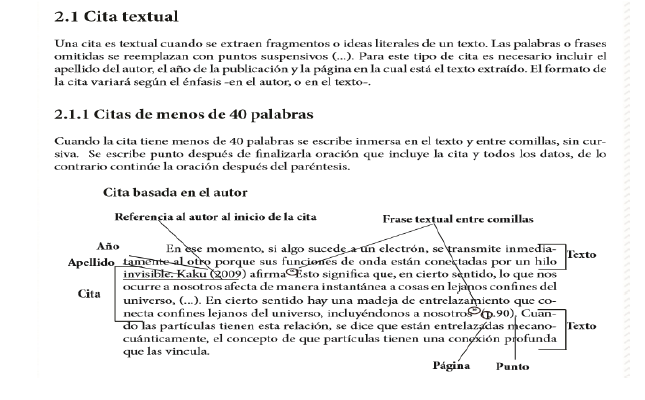
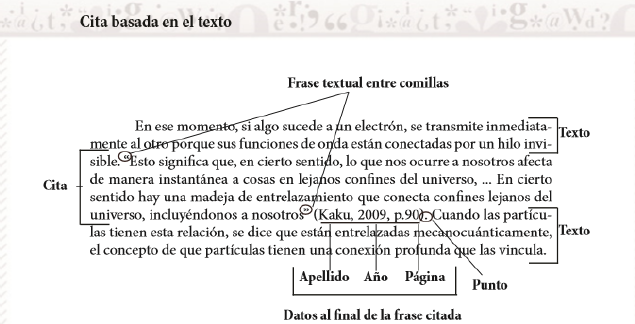
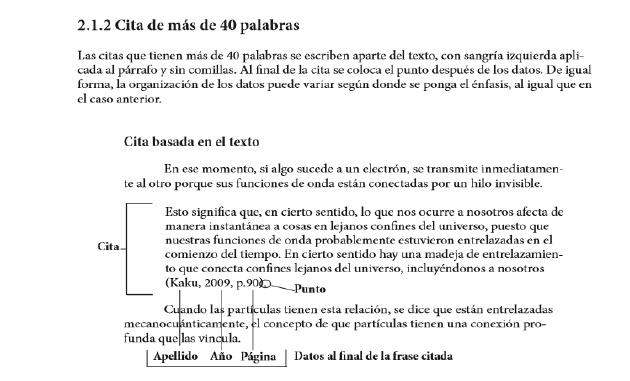
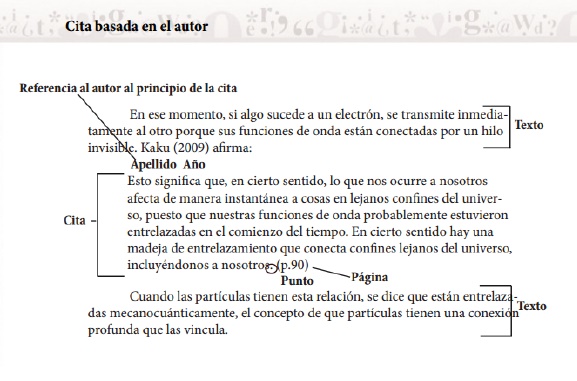
The appointment can be made in a textual or paraphrased manner, for which the number of words cited to set up the appointment is relevant, as will be seen below:

Figure 1. Quotations Textual based on the author obtained from APA Standards Sixth Edition Center
Writing Javeriano (2015)

Figure 2. Citation based on the text obtained from APA Standards Sixth Edition Javeriano Writing Center (2015)

Figure 3. Quotation of more than 40 words based on the text obtained from APA Standards Sixth Edition Javeriano Writing Center (2015)

Figure 4. Citation based on the author obtained from APA Standards Sixth Edition Javeriano Writing Center
9. References
At the end of each article, an unnumbered list of the sources used will be placed, trying to follow an alphabetical order in them, with a French indentation and without a vignette. The presentation of the same ones will have to realize according to the norms established by the American Psychological Association 6ª Edition, (APA).
The references are a list with the complete information of the sources cited in the text, which allows to identify and locate them to make sure of the information contained there or complement it, if necessary.
What is the difference between the list of references and the bibliography? In the list of references, the author includes only those sources that he used in his work.
Important: All authors cited in the body of a text or work must match the list of references at the end, never refer an author who has not been cited in the text and vice versa. (Javeriano Writing Center, 2015)
10. Article structure
The presentation of the various articles will be carried out through two different formats: original research articles and review articles. Due to the journal's own considerations, the different formats are defined and detailed below:
10.1 Original research article: Document that presents, in a detailed manner, the original results of completed research projects.
The structure of the original research article must have the following parts:
● Summary
● Keywords (see section 4)
● Introduction
● Methodology
● Results
● Discussion
● References (see section 8)
Summary: This should have a minimum of 150 words and a maximum of 250 words, clearly indicating the subject, the objectives and the main conclusion. The breakdown of information within this section must be presented as a mini IMRyD, without there being any differentiation between the parties. This in order to present the reader with a brief look at the subject of the article. Also, within it should not use quotes or acronyms.
Introduction: Collect information about the purpose of the investigation and the importance of it. It should also include the objectives, problem statement, hypothesis (if applicable) and conceptual framework. These elements must be presented clearly, without falling into unnecessary depths and without paragraphs.
Take into account that the data presented within this section should be presented in such a way as to show the reader a general overview, which will gradually take it to the specific topic of the study.
Methodology: Describes in detail the way in which the study was conducted from the type of research, population and sample (if applicable); instruments used for the collection of information and the processing thereof.
Results: This section summarizes the most relevant data collected and the type of analysis performed, which in turn respond to the problem statement presented in the introduction. The internal structuring of this section will depend on the amount and type of data collected (see section number 3).
Discussion: Once the results are presented, we proceed to evaluate and interpret their implications, especially referring to the main purpose of the research that is to answer the research question. It is recommended to emphasize the importance of the results and the validity of the conclusions.
Unlike the introduction, this section breaks down the information starting from the specific to the general, in order to leave the reader with a holistic view of the problem, based on the author's reflection at the moment of contrasting the theory with reality. .
It should be avoided to result in data that have already been addressed in the results, except that
There is a relevance to support the conclusions reached. The sections and bullet points should be avoided, unless the information so requires.
10.2 Review article: Document resulting from a bibliographic study in which information published on a topic in the area of education is compiled, analyzed, synthesized and discussed, in order to account for the progress and trends of its development. It is characterized by presenting a range of between 15 to 30 references.
The structure of the review articles should have the following parts:
● Summary
● Keywords (see section 4)
● Introduction
● Development
● Conclusions
● References (see section 8)
Summary: This should have a minimum of 150 words and a maximum of 250 words, clearly indicating the subject, the objectives and the main conclusion. The breakdown of information within this section must be presented as a mini IMRyD, without there being any differentiation between the parties. This in order to present the reader with a brief look at the subject of the article. Also, within it should not use quotes or acronyms.
Introduction: The background and reasons for approaching the subject under review are presented, in order to present the reader with a broad panorama of information related to the subject. A thorough review of documents should be done, with the purpose of not leaving any text that is relevant to the investigation. The structure shows the information starting from a general panorama towards the specific.
Development: The method used and the selection criteria for gathering information are explained with precision, in order to avoid biases in the review, presenting in a clear way the synthesis of the results found and the most relevant aspects.
Conclusions: These are written based on the most important inferences during the review. Likewise, they must be clear and forceful, without being superfluous or wandering in the ideas link. It is recommended to emphasize the importance of the results and the validity of the conclusions.
Unlike the introduction, this section breaks down the information starting from the specific to the general, in order to leave the reader with a holistic view of the problem, which leads to the reflection of contrasting theory with practice. It should be avoided to result in data that have already been addressed in the results, unless there is a relevance to support the conclusions reached.
11. Arbitration process
All articles are reviewed by the Scientific - Editorial Coordination, which verifies the
compliance with the criteria requested for publication.
After this review, the documents are sent to the Scientific Arbitration Committee. The process under which the articles are arbitrated corresponds to the double blind modality, in order to issue an opinion with the least possible subjectivity, providing quality and credibility to the content. For each article, a total of three specialist arbitrators are assigned within the theme. The distribution of the referees may vary depending on the number of specialists, the subject (multidisciplinary approach) and the scope of it.
The Editorial Coordination of the journal takes a maximum of 60 days to review the content aspects and notify the author about its acceptance, observation and / or rejection of the article. Accepted the articles and made the adjustments and the precisions to that it would have place, these happen to grammatical and orthographic correction, in whose process the particular style of each author is respected. This correction is of form, never of content. In addition, each referee must attach the valuation form of the article
In special cases, in which the author (authors) receives a notification with observations and they do not comply with them, the publication or rejection of the article is at the editor's discretion.
12. Scientific Committee
The Scientific Committee is made up of an authority with institutional links and professionals external to the university, who verify the relevance of each of the topics, in terms of the institutional philosophy and the correspondence of the same to the research lines contemplated within the Research Policy and Social Projection of the university.
13. Scientific Arbitration Committee
The professionals that are part of the Scientific Arbitration Committee are selected according to their experience and contributions within the different topics. Once the evaluation process has been carried out by the selected arbitrators, the Editorial Committee reviews the results of these evaluations and decides (within a maximum period of 2 weeks) if the article is accepted or rejected, in accordance with the criteria of the arbitrators.
This committee is organized and led by the editor; In addition, it has the particularity of being variable in terms of quantity and the members that comprise it, since it responds to the topics that are presented within each edition and the contributions that the editor considers necessary. The members of this committee can have both institutional and external linkage, but comply with the principle of specialization within the area in which their support is requested.
For the assignment of the arbitrators is taken as a principle of selection, not only their correspondence within the area, but also that their maximum academic degree is equivalent or greater than the professional who evaluates.
14. Article accepted
To be published within Educational Knowledge, each article must add a minimum amount of 75 points to be accepted. In the case of receiving the final acceptance of the manuscript, the author will be notified by email, enclosing the consolidated arbitration process. After this the document will go through the Style Correction process.
15. Article accepted with observations
This happens when the article obtains the minimum required score, but the arbitrators consider that certain adjustments must be made to the content of the article. In this case, the author will receive the notification via email, enclosing the consolidated arbitration process within which the relevant modifications will be specified. The requested changes to the document must be sent by the author within a maximum period of eight calendar days.
Some considerations regarding the accepted article with observations:
a. If the observations made by the arbitrators may not be complied with by the author, if he considers that they do not apply within the framework of his investigation. If so, the author must send along with his modified article, a clarification of the reason for said actions.
b. If the author has difficulties in delivering the corrected article, he must notify the Editorial Coordination in good time. This may grant an extension of up to 15 calendar days maximum, as the case may be.
c. If in spite of being assigned an extension, the author did not send his article with the requested modifications, the article will not be published.
16. Article rejected
It is applied when the article not only has not complied with the minimum percentage of acceptance, but also does not meet any of the following requirements:
Depending on the circumstances, a rejected article may be reelected for the next edition of the journal, with the commitment to improve any of the above points. In this case, the article will be submitted to the same process.
17. Appeal process
If an author is convinced that an incorrect decision has been made regarding his article, EDUCATIONAL KNOWLEDGE allows him to submit a single appeal. The appeal must be sent with detailed information about the reasons why the initial decision was wrong.
The situation will be addressed by the Editorial Board of the journal within a period of one month, in order to verify the validity of the arguments. In some cases, the process may involve a new revision of the article. The new decision is considered final, and the author will be notified within a maximum period of three months.
Special considerations
Todos los envíos deben cumplir los siguientes requisitos.
© Conocimiento Educativo
The copyright of the articles is transferred to the journal Conocimiento Educativo
As a user of this journal, you have:
● Open access to consult the information contained in this number
● Permission to copy, distribute, display, perform or combine the above practices, regarding the use of the information, as long as it is strictly non-profit.

This work is licensed under a Creative Commons Attribution-NonCommercial 4.0 International License.
Central American Journals Online (CAMJOL) is a member of the Ubiquity Partner Network coordinated by Ubiquity Press. According to the EU definitions, CAMJOL is the data controller, and Ubiquity Press are the service providers and data processors. Ubiquity Press provide the technical platform and some publishing services to CAMJOL and operate under the principle of data minimisation where only the minimal amount of personal data that is required to carry out a task is obtained.
More information on the type of data that is required can be found in Ubiquity Press’ privacy policy below.
We take seriously our duty to process your personal data in a fair and transparent way. We collect and manage user data according to the following Privacy Policy. This document is part of our Terms of Service, and by using the press portal, affiliated journals, book, conference and repository websites (the “Websites”), you agree to the terms of this Privacy Policy and the Terms of Service. Please read the Terms of Service in their entirety, and refer to those for definitions and contacts.
There are four main categories of personal data stored by our journal platform, our press platform, and our book management system; Website User data, Author data, Reviewer data and Editor data.
The minimum personal data that are stored are:
Optionally, the user can provide:
The data subjects have complete control of this data through their profile, and can request for it to be removed by contacting info@ubiquitypress.com
We regularly backup our databases, and we use reliable cloud service providers (Amazon, Google Cloud, Linode) to ensure they are kept securely. Backups are regularly rotated and the old data is permanently deleted. We have a clear internal data handling policy, restricting access to the data and backups to key employees only. In case of a data breach, we will report the breach to the affected users, and to the press/journal contacts within 72 hours.
Personal information is only used to deliver the services provided by the publisher. Personal data is not shared externally except for author names, affiliations, emails, and links to ORCiD and social media accounts (if provided) in published articles and books which are displayed as part of the article/book and shared externally to indexes and databases. If a journal operates under open peer review then the reviewer details are published alongside the reviewer details.
1.1 what data we collect
1.2 why we collect the data
1.3 what we do (and don’t do) with the data
1.4 what to do if you want to get a copy of your data, or want your data to be removed
2.1 what data we collect
2.2 why we collect the data
2.3 what we do (and don’t do) with the data
2.4 why we store the data
2.5 what to do if you want to get a copy of your data, or want your data to be removed
3.1 what data we collect
3.2 why we collect the data
3.3 what we do (and don’t do) with the data
3.4 what to do if you want to get a copy of your data, or want your data to be removed
4.1 what data we collect
4.2 why we collect the data
4.3 what we do (and don’t do) with the data
4.5 what to do if you want to get a copy of your data, or want your data to be removed
5.1 what data we collect
5.2 why we collect and store the data, and for how long
5.3 what we do (and don’t do) with the data
5.4 what to do if you want to get a copy of your data or want your data to be removed
We may choose to buy or sell assets. In the case that control of data changes to or from Ubiquity Press and a third party, or in the case of change of ownership of Ubiquity Press or of part of the business where the control of personal data is transferred, we will do our best to inform all affected users and present the options.
(Updated: 10 September 2025)
Established in 2011 and hosted by Ubiquity.
Managed by Mongolian Academy of Sciences.
This website supports the online publication of Mongolian journals. For more information about MongoliaJOL and how to join the service see the About page.