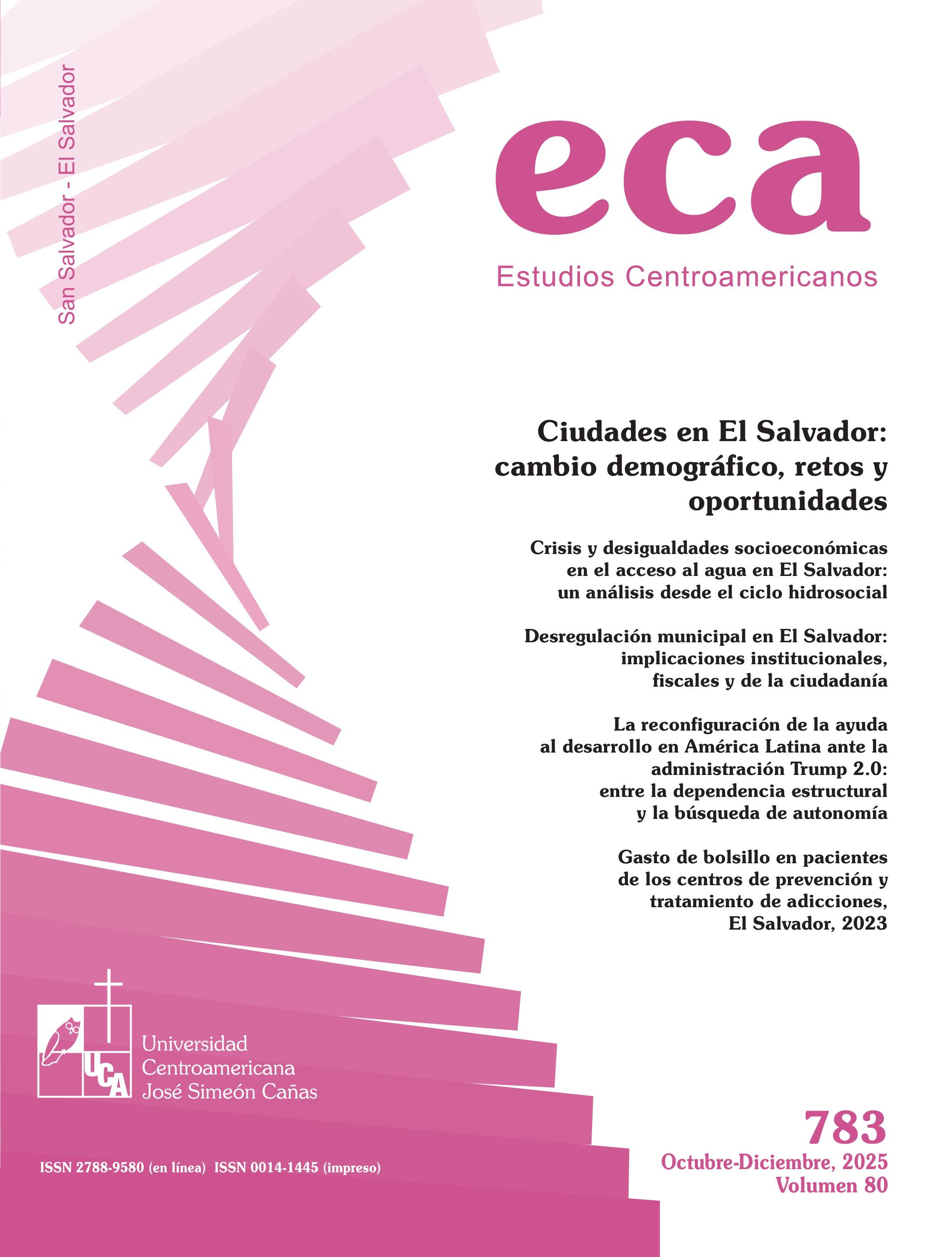
The Reconfiguration of Development Aid to Latin America Under the Trump 2.0 Administration: Between Structural Dependence and the Quest for Autonomy
DOI:
https://doi.org/10.51378/eca.v80i783.10080Keywords:
Official development assistance, International cooperation, South-south cooperation, Foreign policy, International relationsAbstract
This article analyzes the reconfiguration of development aid architecture in Latin America during Donald Trump’s second administration from a structuralist and neorealist perspec-tive. Using primary and secondary sources, it examines the extent to which the withdrawal of US cooperation—manifested in the contraction of USAID, the subordination of aid to strategic interests such as security and migra-tion containment, and the weakening of multi-lateralism—has transformed the international cooperation system or, on the contrary, repre-sents a phase of continuity within its structural logic of power. The study also explores the expansion of China as an alternative actor, whose strategy of influence combines financial, institutional, and cultural instruments articu-lated around the Belt and Road Initiative and the narrative of South-South cooperation. It also analyzes the responses of Latin American countries to this scenario, characterized by defensive diplomacy and fragmented efforts at regional coordination that oscillate between the search for autonomy and the reproduction of new dependencies. Overall, the article offers analytical tools for understanding the tensions between continuity and change in the global development architecture, as well as the dilemmas facing Latin America in the contemporary hegemonic dispute between Washington and Beijing.
23
EPUB (Español (España)) 22
Published
How to Cite
Issue
Section
License

This work is licensed under a Creative Commons Attribution-NonCommercial-NoDerivatives 4.0 International License.
© ECA. Estudios Centroamericanos está bajo una licencia Creative Commons NonCommercial-NoDerivatives 4.0 International (CC BY-NC-ND 4.0).

La licencia no comercial y sin obra derivada permite la reproducción, distribución y comunicación pública, pero no la posibilidad de comercializar su contenido ni tampoco generar una obra derivada, como una traducción o adaptación, excepto que se pida permiso a los editores de dicha obra.
En ese sentido, se está en la libertad de:
Compartir: copiar y redistribuir el material en cualquier medio o formato.
Bajo las siguientes condiciones:
- Reconocimiento: se debe dar crédito a esta obra de manera adecuada, proporcionando un enlace a la licencia, e indicando si se han realizado cambios.
- Uso no comercial: no se puede hacer uso del material con fines comerciales.
- Sin obra derivada: si se remezcla, transforma o construye sobre ese material, no se puede distribuir el material modificado.

