
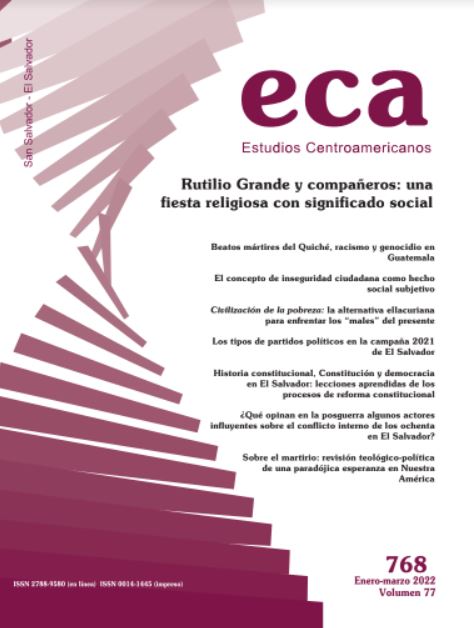
Constitutional history, Constitution and democracy in El Salvador: Lessons learned from the processes of constitutional reform
DOI:
https://doi.org/10.51378/eca.v77i768.6681Keywords:
Constitutional reform, Constitution, Constitutional changeAbstract
This article aims to reflect on the processes oriented to the generation of proposals for constitutional change in the Latin American context, and particularly in El Salvador, from a historical analysis perspective. Through constitutional history we can identify and make visible the forces, interests and intentions present in the initiatives of constitutional reform or change, showing that in many cases the narrative of constitutional changes does not necessarily have a direct relationship with the intentionality of the interest groups of the actors interested in the reform. Sometimes, as we say in good Salvadoran, legal reforms — including constitutional reforms — are only a “salute to the flag”, but on other occasions —especially in those processes that have started from an open, democratic and participatory process that has taken into account those voices that are not the majority — reforms and legal frameworks that have an impact on the daily reality can be included... and on other occasions, the reforms or changes seek objectives or goals that are not explicit. Through an exercise of historical analysis of constitutional reform processes in El Salvador, particularly of the reform processes that achieved a change of the Constitution during the stage known as el Martinato in El Salvador, we can observe how the initiatives of constitutional change or reform can be oriented to generate impacts that were not initially foreseen, even when the reform process itself involves actors that seek to positively influence the improvement of the normative frameworks. Likewise, this exercise shows us that social movements and processes can be alien to the processes of constitutional reform or change, preventing or limiting the effects of a new regulatory framework, on the one hand, when they are alien to the community and the population or, the community could not see the political background if what is intended is to give legitimacy to an illegitimate government.
28
References
Artiga, Á. (2015). El Sistema Político Salvadoreño. PNUD-AECID.
Castillo Amaya, L. (2012). La historia constitucional de la integración centroamericana. Un estudio desde el derecho comparado. Realidad y Reflexión, 12(36), 71-95. https://ri.ufg.edu.sv/jspui/bitstream/11592/8318/1/La%20historia%20constitucional%20de%20la%20integraci%C3%B3n%20Centroamericana.%20%20Un%20estudio%20desde%20el%20derecho%20comparado.pdf
Chanta Martínez, R. A. (2018). Antilaicismo, anticomunismo y críticas a la masonería en la prensa católica salvadoreña durante el retorno del debate de la laicidad del Estado (1938-1940). Revista de Estudios Históricos de la Masonería Latinoamericana y Caribeña, 10(1), 299-323. https://dx.doi.org/10.15517/rehmlac.v10i1.32419
Clavero, B. (1994). Espacio colonial y vacío constitucional de los derechos indígenas. Anuario Mexicano de Historia del Derecho, 6, 61-86. https://revistascolaboracion.juridicas.unam.mx/index.php/anuario-mexicano-historia-der/article/view/29509/26632
Clavero, B. (1997). Imperio de la ley, regla del derecho y tópica de constitución. Anuario de la Facultad de Derecho de la Universidad Autónoma de Madrid, 41-78. http://afduam.es/wp-content/uploads/pdf/1/clavero_bartolome.Pdf
Clavero, B. (2018). De alienígenas chinos e indígenas yaquis (ubicando el constitucionalismo latinoamericano). Anuario de Historia de América Latina, 55, 127-151. https://doi.org/10.15460/jbla.55.69
Gargarella, R. (2014). La sala de máquinas de la Constitución. Dos siglos de constitucionalismo en América Latina (1810-2010). Katz.
Grieb, K. J. (1971). The United States and the Rise of General Maximiliano Hernandez Martinez. Journal of Latin American Studies, 3(2), 151-172. https://doi.org/10.1017/S0022216X00001425
Luna, D. (1969). Análisis de una dictadura fascista latinoamericana. Maximiliano Hernandez Martínez 1931-1944. La Universidad, 94(5), 39-130. https://revistas.ues.edu.sv/index.php/launiversidad/article/view/1119/1045
Méndez, J. M. (1998). Historia constitucional de El Salvador (tomo V). UTEC.
Monterrosa-Cubías, G. (2016). Preparando al verdadero ciudadano y centinela ejemplar que velará por el honor de la República. El Salvador, 1933. Revista LiminaR. Estudios Sociales y Humanísticos, 14(2), 199-204. http://www.scielo.org.mx/scielo.php?script=sci_arttext&pid=S1665-80272016000200199
Parkman, P. (2003). Insurrección no violenta en El Salvador: la caída de Maximiliano Hernández Martínez. DPI.
Popkin, M. (2000). Peace without Justice: Obstacles to Building the Rule of Law in El Salvador. Penn State University Press.
Preza Medrano, M. (2014). Maximiliano Hernández Martínez: campe s i n o, militar, gobernante y dictador. Ensayos Contemporáneos, 11(64).
Unidad Técnica Ejecutiva del Sector de Justicia [UTE]. (1993). Las constituciones de la República Federal de Centroamérica,1983-1993. Diez años de la Constitución de El Salvador (tomo I). Talleres Gráficos UCA.
Urbina Gaitán, C. (2018). La matanza de 1932 en El Salvador en la prensa guatemalteca. Ciencias Sociales y Humanidades, 5(1), 103-107. https://revistas.usac.edu.gt/index.php/csh/article/view/642/593
Downloads
Published
How to Cite
Issue
Section
License

This work is licensed under a Creative Commons Attribution-NonCommercial-NoDerivatives 4.0 International License.
© ECA. Estudios Centroamericanos está bajo una licencia Creative Commons NonCommercial-NoDerivatives 4.0 International (CC BY-NC-ND 4.0).

La licencia no comercial y sin obra derivada permite la reproducción, distribución y comunicación pública, pero no la posibilidad de comercializar su contenido ni tampoco generar una obra derivada, como una traducción o adaptación, excepto que se pida permiso a los editores de dicha obra.
En ese sentido, se está en la libertad de:
Compartir: copiar y redistribuir el material en cualquier medio o formato.
Bajo las siguientes condiciones:
- Reconocimiento: se debe dar crédito a esta obra de manera adecuada, proporcionando un enlace a la licencia, e indicando si se han realizado cambios.
- Uso no comercial: no se puede hacer uso del material con fines comerciales.
- Sin obra derivada: si se remezcla, transforma o construye sobre ese material, no se puede distribuir el material modificado.

