
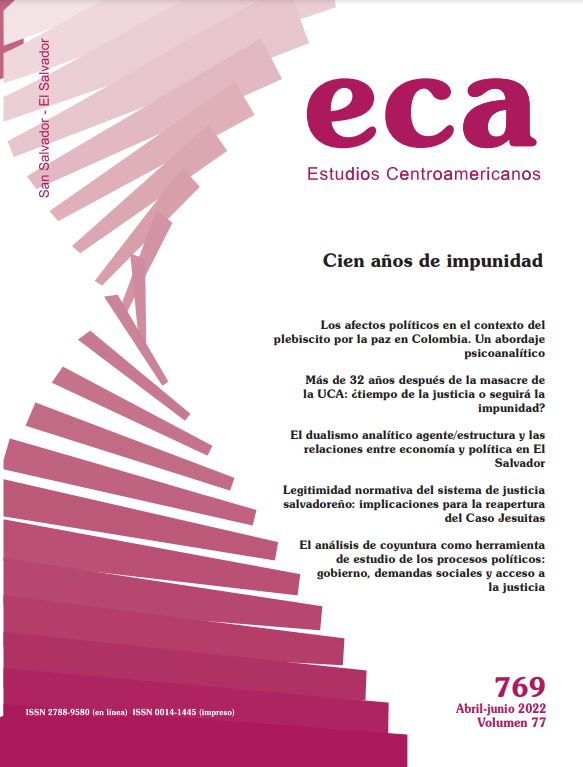
Political affects in the context of the plebiscite for peace in Colombia: A psychoanalytic approach
DOI:
https://doi.org/10.51378/eca.v77i769.6891Keywords:
Barriers for the construction of peace, Affects, Armed conflict, Peace building and social bondsAbstract
The purpose of the present article was to inquire, from a psychoanalytic point of view, the logic that underlies the affects present in 43 semi-structured and in-depth interviews conducted in the city of Medellín, in the context of the political negotiation process of the armed conflict and the peace agreement between the Colombian government and the Fuerzas Armadas Revolucionarias de Colombia (FARC-EP), particularly after the Plebiscite for Peace of October 2nd, 2016. This qualitative research, carried out within the context of the project “Psychosocial barriers for the construction of peace and reconciliation in Colombia”, had a phenome- nological-hermeneutical approach, from where we analyzed the content of the interviews based on the psychoanalytic theory of affects. This allowed the design of a matrix based on three main categories: subject/subjectivity, Other/speech and enjoyment, from which eleven affects emerged: love, hatred, igno- rance, indifference, hope, fear, indignation, resentment, shame, modesty and disgust. We found that fear is the main affect which links all the other affects, and is a starting point for the manipulation of people, operating as an effective way to arouse other affects such as hatred. These affects have anguish at their core, stemming from what Freud called “the original helplessness”, that maintains a rela- tionship with the Other, who can be seen as a source of protection or a threat. This resulted in the appearance of affects that touch reality such as disgust, shame and modesty; the latter two considered necessary for one’s ability to think, as well as in producing hope, social bonding and the building of paths that lead to peace.
26
Downloads
Published
How to Cite
Issue
Section
License
Copyright (c) 2022 ECA: Estudios Centroamericanos

This work is licensed under a Creative Commons Attribution-NonCommercial-NoDerivatives 4.0 International License.
© ECA. Estudios Centroamericanos está bajo una licencia Creative Commons NonCommercial-NoDerivatives 4.0 International (CC BY-NC-ND 4.0).

La licencia no comercial y sin obra derivada permite la reproducción, distribución y comunicación pública, pero no la posibilidad de comercializar su contenido ni tampoco generar una obra derivada, como una traducción o adaptación, excepto que se pida permiso a los editores de dicha obra.
En ese sentido, se está en la libertad de:
Compartir: copiar y redistribuir el material en cualquier medio o formato.
Bajo las siguientes condiciones:
- Reconocimiento: se debe dar crédito a esta obra de manera adecuada, proporcionando un enlace a la licencia, e indicando si se han realizado cambios.
- Uso no comercial: no se puede hacer uso del material con fines comerciales.
- Sin obra derivada: si se remezcla, transforma o construye sobre ese material, no se puede distribuir el material modificado.

