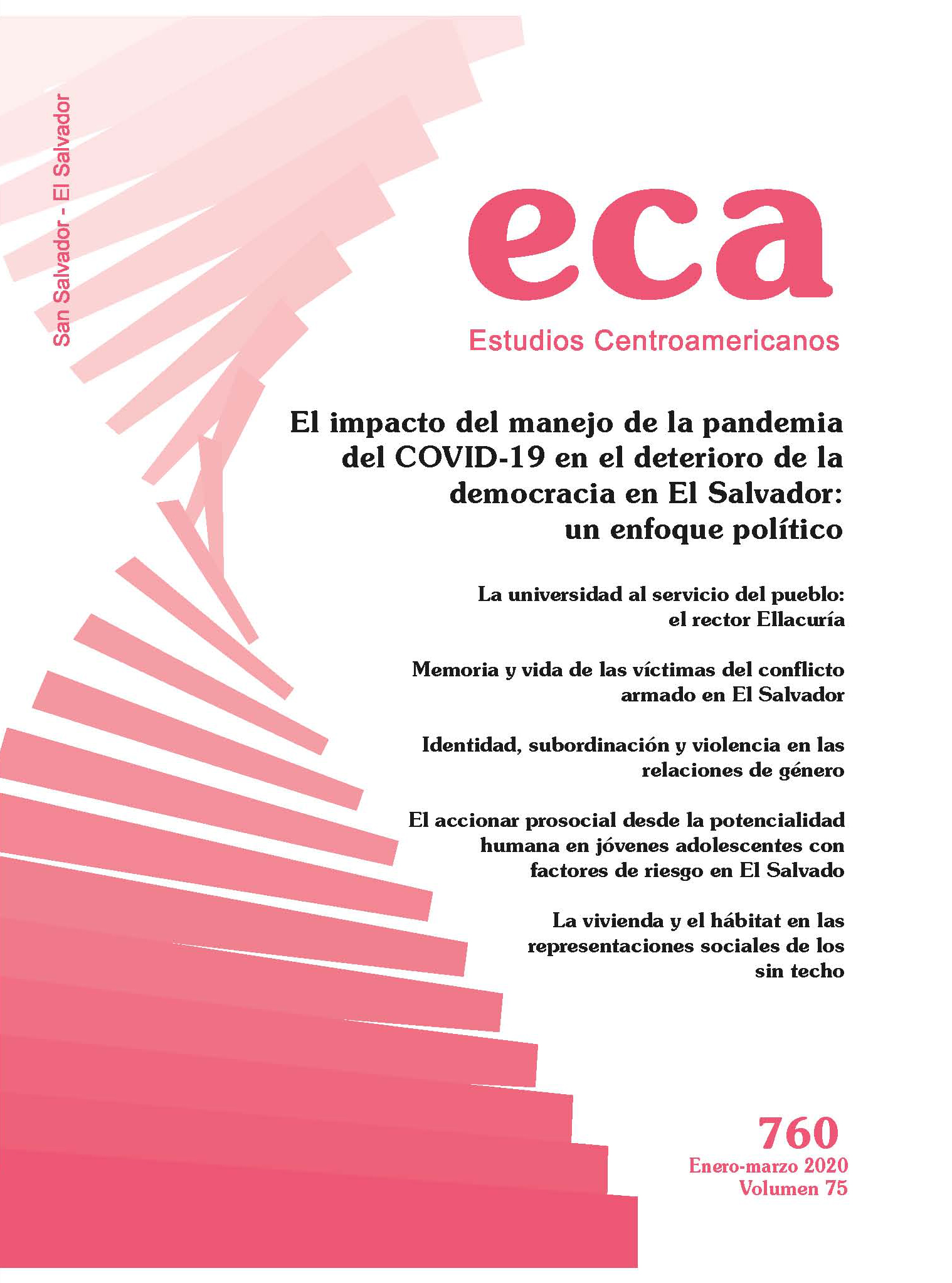
Memory and life of victims of the conflict armed in El Salvador
DOI:
https://doi.org/10.51378/eca.v75i760.3292Keywords:
Lived time, Memory, Denial, Memory Loss, Revictimization, Pain, HealingAbstract
The article explores the concepts of lived time and memory and their human, historical, sociological, and political implications regarding the silence imposed on the victims of the armed conflict by the perpetrators and their accomplices. Drawing on his eleven years of close work with victims of the armed conflict as part of the International Tribunal for the Application of Restorative Justice in El Salvador, the author argues that the wounds of terror remain alive in the memory of the victims and their descendants, and that the repression of their memory casts a shadow over the future, undermining social cohesion and democracy, while simultaneously causing them to suffer a new and complex form of revictimization. This silence of denial, or “memoricide,” has been and remains a form of permanent psychological torture for the victims and their families, with severe pathological effects. The author argues that any act of repression of individual and collective historical memory—whether stemming from dictatorial regimes or from amnesty laws or “full stop” laws that guarantee impunity for perpetrators of crimes against humanity—regardless of the reason or historical context in which they are enacted, constitutes an instrument against life and a law against human nature that no democratic society respectful of human rights can permit. Therefore, the process of recovering historical memory is a commitment to life, a positive healing experience, and a necessary tool for strengthening democratic and tolerant attitudes in today’s society.
31
Downloads
Published
How to Cite
Issue
Section
License

This work is licensed under a Creative Commons Attribution-NonCommercial-NoDerivatives 4.0 International License.
© ECA. Estudios Centroamericanos está bajo una licencia Creative Commons NonCommercial-NoDerivatives 4.0 International (CC BY-NC-ND 4.0).

La licencia no comercial y sin obra derivada permite la reproducción, distribución y comunicación pública, pero no la posibilidad de comercializar su contenido ni tampoco generar una obra derivada, como una traducción o adaptación, excepto que se pida permiso a los editores de dicha obra.
En ese sentido, se está en la libertad de:
Compartir: copiar y redistribuir el material en cualquier medio o formato.
Bajo las siguientes condiciones:
- Reconocimiento: se debe dar crédito a esta obra de manera adecuada, proporcionando un enlace a la licencia, e indicando si se han realizado cambios.
- Uso no comercial: no se puede hacer uso del material con fines comerciales.
- Sin obra derivada: si se remezcla, transforma o construye sobre ese material, no se puede distribuir el material modificado.

