
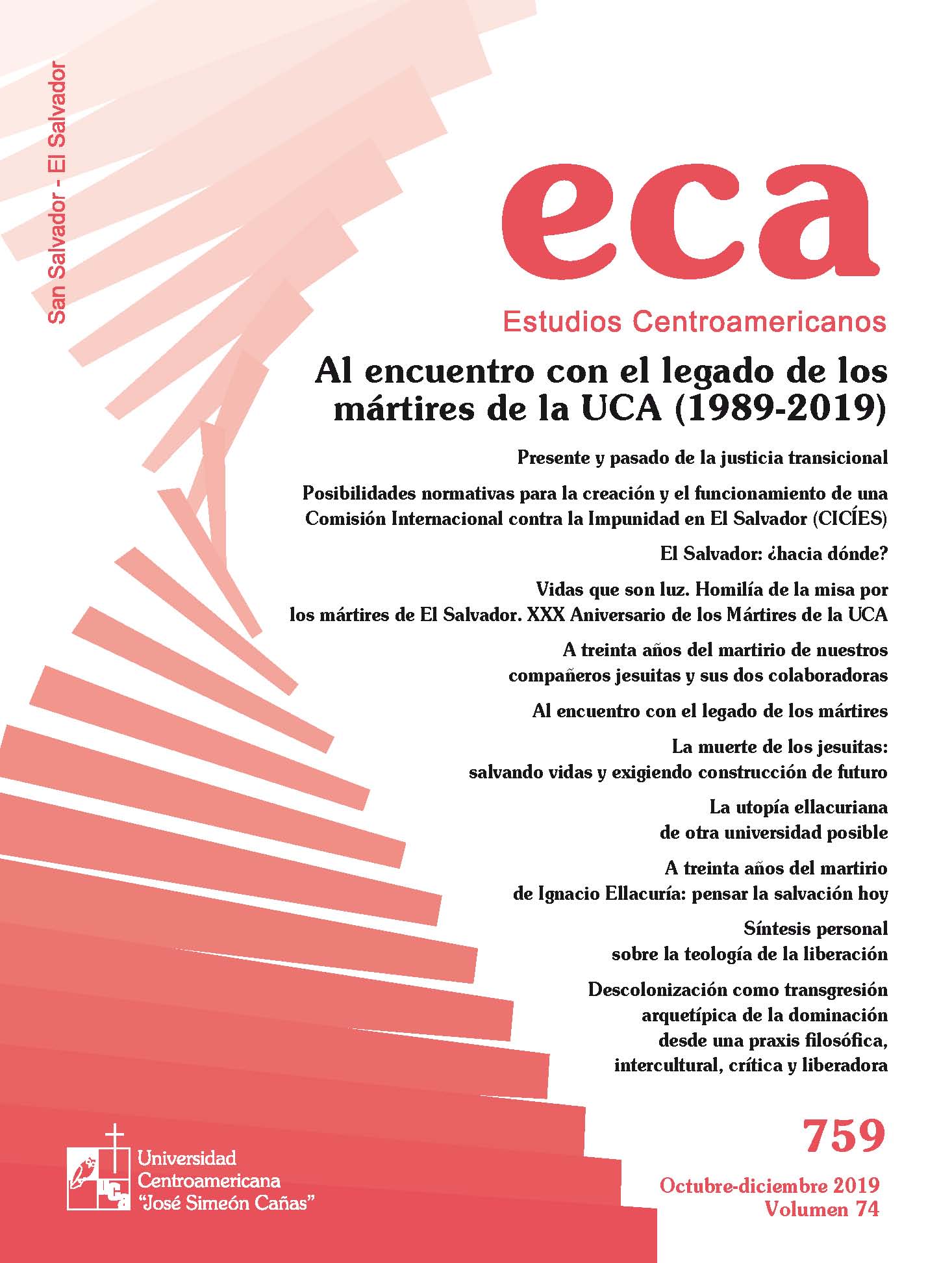
Regulatory possibilities for the creation and operation of an International Commission against Impunity in El Salvador (CICIES)
DOI:
https://doi.org/10.51378/eca.v74i759.1409Keywords:
CICÍES, Impunity, Asamblea Legislativa de El SalvadorAbstract
This article outlines the direction the mandate of the International Commission against Impunity in El Salvador (CICIES) should take in order to have a sufficient sovereign-constitutional basis that allows for its creation and operation without difficulties or opposition. It also explains the substantive and social rationale that would justify the advisability of establishing a commission of this nature. Furthermore, it specifies how the international agreement containing its mandate should be signed and ratified to ensure that its contribution to the judicial system is effective and efficient. This commission could be established and operate without constitutional or legal reforms; however, to ensure the overcoming of any regulatory obstacles, the involvement of the Legislative Assembly is essential. Furthermore, the paper describes the scope of action for this commission within the Salvadoran judicial system, with or without legal reforms, both in investigative work and in the prosecution of criminal cases. It also mentions how civil society could support or rely on this commission to bring charges, with or without the involvement of the Attorney General’s Office (FGR). Attention is also drawn to the need for this commission to be autonomous in many respects, in order to ensure the integrity of the technical criteria guiding its work, although the report highlights the desirability of its contributing to strengthening the FGR’s investigative and prosecutorial capacities in the medium to long term. Furthermore, the various forms of inspection, oversight, and supervision to which it might be subject are mentioned. Finally, the text reflects on the urgency, advisability, and necessity of ensuring that a commission of this nature, dedicated to combating impunity, is not limited to hearing corruption cases but also includes the investigation of other criminal acts related to the current violence.
13
References
Amparo 541-2012, sentencia definitiva del 15 de noviembre de 2013.
Amparo 356-2012, sentencia definitiva del 17 de enero de 2014.
Amparo 549-2012, sentencia definitiva del 14 de febrero de 2014.
Amparo 506-2014, resolución de admisión del 13 de junio de 2014.
Amparo 506-2014, resolución de sobreseimiento del 24 de octubre de 2016.
Amparo 665-2010, sentencia definitiva del 5 de febrero de 2014.
Controversia 1-2018, resolución definitiva del 23 de enero de 2019.
Habeas Corpus 117-2003, sentencia definitiva del 21 de junio de 2004.
Habeas Corpus 174-2005, sentencia definitiva del 12 de julio de 2006.
Habeas Corpus 29-2006, sentencia definitiva del 23 de mayo de 2007.
Habeas Corpus 182-2006, sentencia definitiva del 25 de junio de 2007.
Habeas Corpus 216-2007, sentencia definitiva del 15 de abril de 2008.
Inconstitucionalidad 11-97 Ac, sentencia definitiva del 16 de julio de 2002.
Inconstitucionalidad 2-2005, sentencia definitiva del 28 de marzo de 2006.
Inconstitucionalidad 23-2006, sentencia definitiva del 6 de marzo de 2007.
Inconstitucionalidad 91-2007, sentencia definitiva del 24 de septiembre de 2010.
Inconstitucionalidad 5-2001 Ac, sentencia definitiva del 23 de diciembre de 2010.
Inconstitucionalidad 29-2012, sentencia definitiva del 10 de julio de 2012.
Inconstitucionalidad 13-2012, sentencia definitiva del 5 de diciembre de 2012.
Inconstitucionalidad 6-2009, sentencia definitiva del 19 de diciembre de 2012.
Inconstitucionalidad 2-2010, sentencia definitiva del 21 de junio de 2013.
Inconstitucionalidad 6-2016 Ac, sentencia definitiva del 9 de febrero de 2018.
Downloads
Published
How to Cite
Issue
Section
License

This work is licensed under a Creative Commons Attribution-NonCommercial-NoDerivatives 4.0 International License.
© ECA. Estudios Centroamericanos está bajo una licencia Creative Commons NonCommercial-NoDerivatives 4.0 International (CC BY-NC-ND 4.0).

La licencia no comercial y sin obra derivada permite la reproducción, distribución y comunicación pública, pero no la posibilidad de comercializar su contenido ni tampoco generar una obra derivada, como una traducción o adaptación, excepto que se pida permiso a los editores de dicha obra.
En ese sentido, se está en la libertad de:
Compartir: copiar y redistribuir el material en cualquier medio o formato.
Bajo las siguientes condiciones:
- Reconocimiento: se debe dar crédito a esta obra de manera adecuada, proporcionando un enlace a la licencia, e indicando si se han realizado cambios.
- Uso no comercial: no se puede hacer uso del material con fines comerciales.
- Sin obra derivada: si se remezcla, transforma o construye sobre ese material, no se puede distribuir el material modificado.

