
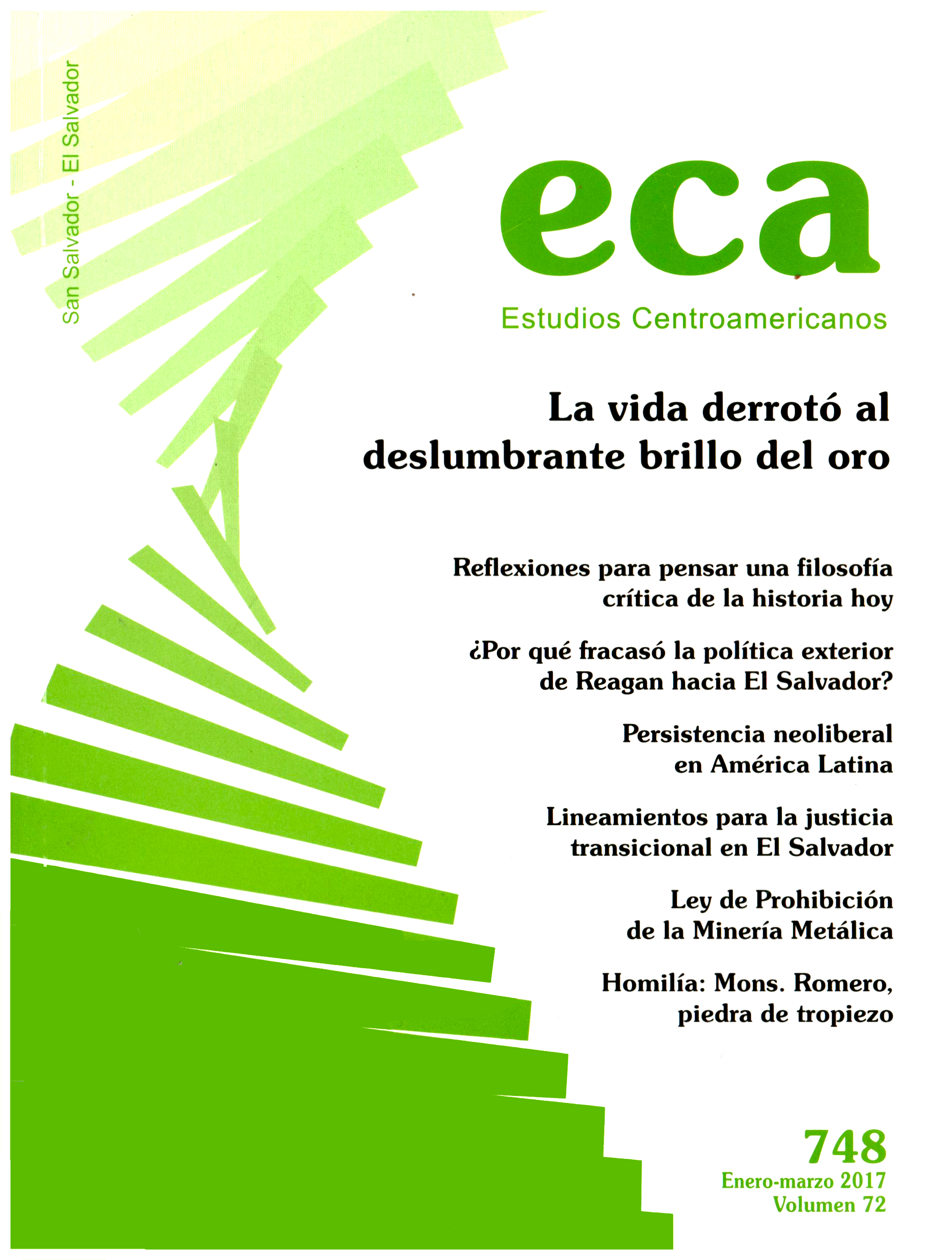
Guidelines for transitional justice in El Salvador
DOI:
https://doi.org/10.51378/eca.v72i748.3239Keywords:
Victims, State, Human rights violation, El SalvadorAbstract
This document, based exclusively on the final judgment 44-2013 Ac, which declared the 1993 General Amnesty Law for the Consolidation of Peace unconstitutional, aims to highlight the rights of victims and their families—affected by both warring parties—as well as the duties of the State. These rights and duties must be taken into account in the implementation of the aforementioned ruling—that is, in the State’s decisions and actions aimed at combating impunity for crimes related to crimes against humanity and war crimes constituting serious violations of constitutional rights, committed during the armed conflict—so that such State decisions and actions are in accordance with the Constitution. The document is divided into two parts: a main section, which contains the “Guidelines for Transitional Justice in El Salvador”; and an appendix, which includes the summary of case law that served as the basis for developing the guidelines and an essential bibliography on transitional justice, which helps to understand its meaning, scope, and components. These guidelines are not a bill, but rather a document that summarizes and reorganizes the rulings of the Constitutional Chamber, intended to serve as a checklist to guide the drafting and discussion of government decisions, thereby ensuring the exercise of the rights of victims and their families and the fulfillment of the State’s obligations.
1
Downloads
Published
How to Cite
Issue
Section
License

This work is licensed under a Creative Commons Attribution-NonCommercial-NoDerivatives 4.0 International License.
© ECA. Estudios Centroamericanos está bajo una licencia Creative Commons NonCommercial-NoDerivatives 4.0 International (CC BY-NC-ND 4.0).

La licencia no comercial y sin obra derivada permite la reproducción, distribución y comunicación pública, pero no la posibilidad de comercializar su contenido ni tampoco generar una obra derivada, como una traducción o adaptación, excepto que se pida permiso a los editores de dicha obra.
En ese sentido, se está en la libertad de:
Compartir: copiar y redistribuir el material en cualquier medio o formato.
Bajo las siguientes condiciones:
- Reconocimiento: se debe dar crédito a esta obra de manera adecuada, proporcionando un enlace a la licencia, e indicando si se han realizado cambios.
- Uso no comercial: no se puede hacer uso del material con fines comerciales.
- Sin obra derivada: si se remezcla, transforma o construye sobre ese material, no se puede distribuir el material modificado.

