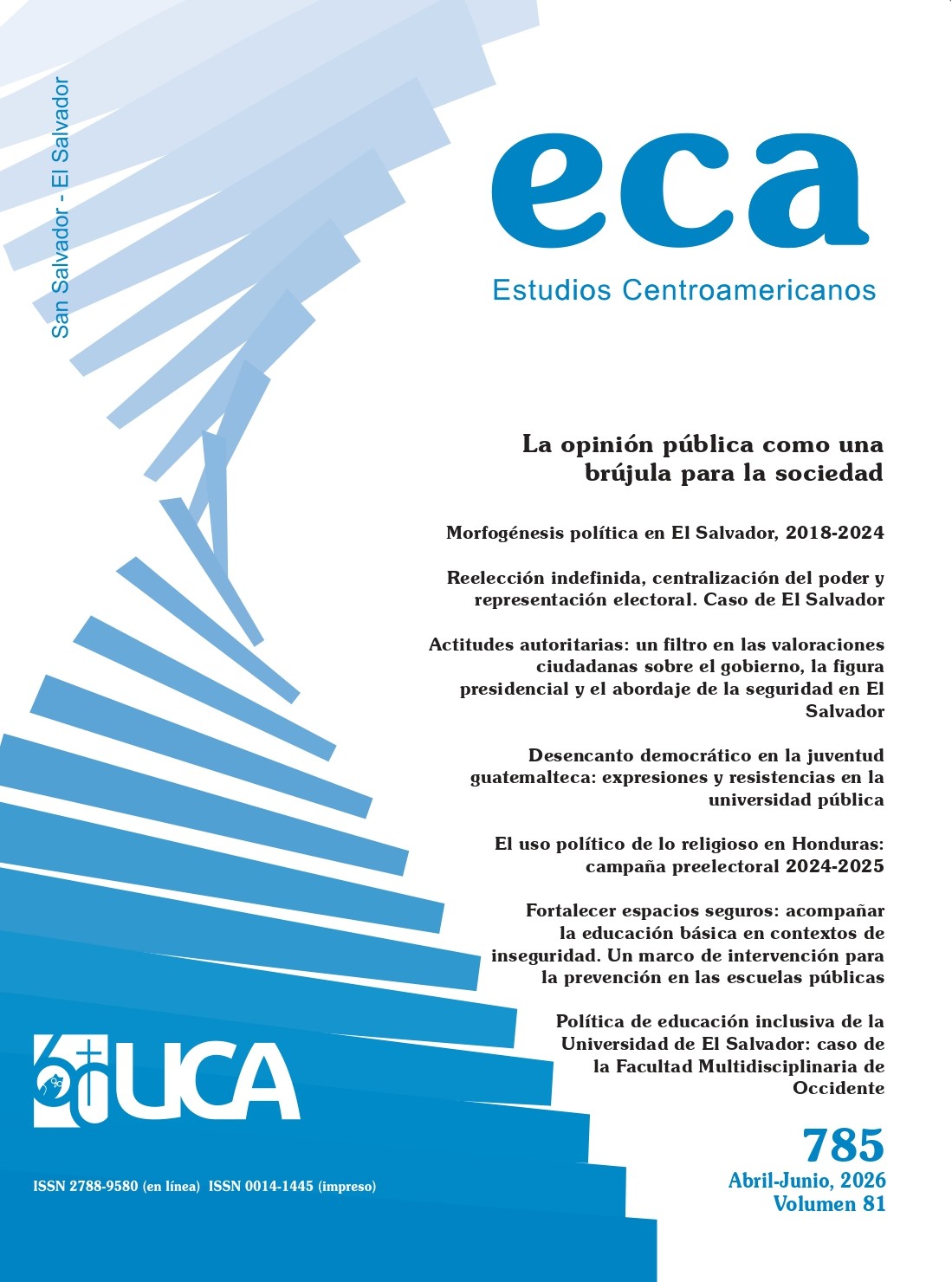
Strengthening Safe Spaces: Accompanying Basic Education in Unsafe Contexts. An Intervention Framework for Prevention in Public Schools
DOI:
https://doi.org/10.51378/eca.v81i785.11454Keywords:
School-based prevention, Violence prevention, Local participation, Social relationships, International development cooperation, Public education, El SalvadorAbstract
In an education crisis, such as the one affecting El Salvador, public schools struggle to provide a safe environment and quality learning in the face of limited state resources and the challenges posed by pre-designed programs implemented by non-governmental organizations. This article presents the Context-Actions-Relationships (CAR) framework, which proposes empowering public schools facing educational emergencies by emphasizing the local context and the education community. CAR was developed by the research program Education in Situations of Risk and Conflict (ESRC) at the UCA university, which studied the challenges faced by public schools in contexts of insecurity and socioeconomic disadvantage. It found a profound impact on the education process, even when schools seem to be functioning with apparent normalcy. The study also highlights the tensions between, on one hand, the situations of insecurity and the socioeconomic conditions of the schools, and, on the other hand, the design and implementation of school-based prevention programs, which affect their quality and effectiveness. The CAR framework identifies three axes to diminish these tensions: contextualization, participation, and social relations. These axes are transversal to each phase of a school-based prevention project’s design and implementation. Although public safety in El Salvador has significantly improved, CAR remains relevant for supporting public schools due to the persistent challenges they encounter and the need for empowerment, as they face a lack of resources and the difficult socio-economic situation of their educational communities.
0
EPUB (Español (España)) 0
References
Aguilar, G. (2025a, 4 de abril). Ascienden a 70 las escuelas públicas cerradas en el país. La Prensa Gráfica. https://www.laprensagrafica.com/elsalvador/Asciende-a-70-las-escuelas-publicas-cerradas-en-el-pais-20250404-0117.html
Aguilar, G. (2025b, 1 de abril). Reportan cierre de 67 escuelas en El Salvador. La Prensa Gráfica. https://www.laprensagrafica.com/elsalvador/Reportan-el-cierre-de-67-escuelas-publicas-en-El-Salvador-20250401-0080.html
Aguilar, G. y Cortez, A. (2025, 18 de agosto). Nueva ministra de Educación ordena verificar uniforme y peinado de los estudiantes. La Prensa Gráfica. https://www.laprensagrafica.com/elsalvador/Nueva-ministra-ordena-verificar-uniforme-y-peinados-de-los-estudiantes-20250818-0074.html
Burde, D., Guven, O., Kelcey, J., Lahmann, H. y Al-Abbadi, K. (2015). What Works to Promote Children’s Educational Access, Quality of Learning, and Wellbeing in Crisis-Affected Contexts. NYU; INEE; UKaid. https://inee.org/sites/default/files/resources/Education-emergencies-rigorous-review-2015-10.pdf
Charmaz, K. (2014). Constructing Grounded Theory (2.a ed.). Sage Publications Ltd.
Cortez, A. (2025a, 20 de febrero). Baja matrícula 2025-Al menos 50,000 alumnos quedarían fuera del sistema educativo. La Prensa Gráfica. https://www.laprensagrafica.com/elsalvador/Baja-matricula-2025-al-menos-50000-alumnos-quedarian-fuera-del-sistema-educativo-20250220-0086.html
Cortez, A. (2025b, 9 de marzo). Cierre de escuelas afecta el acceso a la educación, señalan expertos. La Prensa Gráfica. https://www.laprensagrafica.com/elsalvador/Cierre-de-escuelas-afecta-el-acceso-a-la-educacion-senalan-expertos-20250307-0073.html
Cortez, A. (2025c, 29 de abril). Escuelas sin fondos completos para operar. La Prensa Gráfica. https://www.laprensagrafica.com/elsalvador/Escuelas-sin-fondos-completos-para-operar-20250429-0095.html
Crawford, A. (1998). Crime Prevention & Community Safety. Politics, Policies & Practices. Pearson Education.
Cristosal. (2023). Un año bajo el régimen de excepción: una medida permanente de represión y de violaciones a los derechos humanos. Informe situacional del 27 de marzo de 2022 al 27 de marzo de 2023. https://cristosal.org/ES/wp-content/uploads/2023/07/Informe-1-ano-regimen-de-excepcion_digital.pdf
Cristosal. (2024). El silencio no es opción. Investigación sobre las prácticas de tortura, muerte y justicia fallida en el régimen de excepción. https://cristosal.org/ES/el-silencio-no-es-opcion-informe-completo/
Darling, N., Hamilton, S. F. y Hames Shaver, K. (2006). Relationships Outside the Family: Unrelated Adults. En G. R. Adams y M. D. Berzonsky (Eds.), Blackwell Handbook of Adolescence (pp. 349-370). Blackwell Publishing.
DevTech Systems Inc. (2024). Latin America and the Caribbean Inclusive Education Landscape Assessment.
Dimas, A. (2025). La silenciosa crisis educativa de El Salvador. El Faro. https://elfaro.net/es/202502/el_salvador/27755/La-silenciosa-crisis-educativa-de-El-Salvador.htm
Flores Espinoza, M. R. (2024). Por qué y cómo prevenir: La acción transformadora de las teorías de cambio en la prevención de violencia en las escuelas en El Salvador. ECA: Estudios Centroamericanos, 79(778), 117-139. https://revistas.uca.edu.sv/index.php/eca/article/view/9116
Harries, E., Hodgson, L. y Noble, J. (2014). Creating your theory of change. NPC’s practical guide. NPC. https://www.thinknpc.org/wp-content/uploads/2018/07/Creating-your-theory-of-change1.pdf
Human Rights Watch. (2025). El Salvador: Police Officers Speak Out About Abuses. Arbitrary Detention Based on Quotas, Fabricated Evidence. https://www.hrw.org/news/2025/06/27/el-salvador-police-officers-speak-out-about-abuses
Infosegura. (2017). Índice de priorización de municipios. Herramientas para la priorización y focalización de políticas en materia de seguridad ciudadana. USAID; PNUD. https://www.seguridad.gob.sv/dia/download/indice-de-priorizacion-de-municipios/
Instituto Universitario de Opinión Pública. (2023). La población salvadoreña evalúa el primer año del régimen de excepción. Boletin de prensa, XXXVII(5), 1-29. https://uca.edu.sv/iudop/wp-content/uploads/2023/03/Bol.-Regimen-de-Excepcion-1-anio.pdf
Instituto Universitario de Opinión Pública. (2024). La población salvadoreña evalúa el segundo año del régimen de excepción. Boletin de prensa, XXXVIII(3), 1-33. https://uca.edu.sv/iudop/wp-content/uploads/2024/04/Bol.-Regimen-de-Excepcion-V2.pdf
Ministerio de Educación, Ciencia y Tecnología. (2025). Memorándum N.° 06-2025. MINEDUCYT.
Nicolai, S., Hine, S. y Wales, J. (2015). Education in Emergencies and Protracted Crises. Toward a Strengthened Response. Overseas Development Institute. https://inee.org/sites/default/files/resources/9714.pdf
Portillo, D. (2025, 3 de julio). Oficialismo aprueba la prórroga 40 del régimen de excepción. La Prensa Gráfica. https://www.laprensagrafica.com/elsalvador/Oficialismo-aprueba-prorroga-40-del-regimen-de-excepcion-20250703-0066.html
Savenije, W. y Amaya Cóbar, E. (2025). Democratic Backsliding and Security Governance in Central America: Research and Dialogue. USAID; Netherlands Institute for Multiparty Democracy. https://centralamerica.nimd.org/wp-content/uploads/2025/05/Democratic-Backsliding-and-Security-Governance-CA-VF-1.pdf
Savenije, W. y Beltrán, M. A. (2012). Conceptualización del Modelo de Prevención Social de la Violencia con Participación Juvenil. Instituto Nacional de la Juventud (INJUVE).
Savenije, W. y Martin, P. (2020). La integración social desde la educación en contextos de inseguridad: repensar el papel de la comunidad educativa. Universidad Centroamericana José Simeón Cañas.
Savenije, W., Martin, P., Cabrera, A. y Molina, S. (2022). Marco de Intervención para la prevención en escuelas públicas. Fortalecer espacios seguros. Acompañar a la educación básica en contextos de inseguridad. Universidad Centroamericana José Simeón Cañas. https://inee.org/sites/default/files/resources/Savenije,%20Martin%20y%20otros.%202022.%20ESRC_Marco%20de%20intervenci%C3%B3n%20para%20la%20prevenci%C3%B3n%20en%20escuelas%20p%C3%BAblicas.pdf
Savenije, W., Martin, P., y Cabrera Ventura, A. (2022). Profesores, escuelas y comunidades: Fortalecer espacios seguros. Hacia un marco de prevención escolar. Informe de investigación. Universidad Centroamericana José Simeón Cañas.
Stoff, C. y Valenza, M. (2025). State of Education for Crisis-Affected Children and Adolescents: Access and Learning Outcomes. Global Estimates 2025 Update. Education Cannot Wait. https://www.educationcannotwait.org/sites/default/files/2025-01/global_estimates_report_2025.pdf
Sutton, A., Cherney, A. y White, R. (2014). Crime Prevention. Principles, perspectives and practices. Cambridge University Press.
The Economist. (2025, 6 de marzo). The death of giving. The demise of foreign aid offers an opportunity. Donors should focus on what works. Much aid currently does not. https://www.economist.com/leaders/2025/03/06/the-demise-of-foreign-aid-offers-an-opportunity
Tilley, N. (2009). Crime Prevention. Willan Publishing.
Urbina, J. (2022, 29 de marzo). Capturas masivas duplicaría hacinamiento. La Prensa Gráfica. https://www.laprensagrafica.com/elsalvador/Capturas-masivas-duplicaria-hacinamiento-20220328-0073.html
Published
How to Cite
Issue
Section
License
Copyright (c) 2026 ECA: Estudios Centroamericanos

This work is licensed under a Creative Commons Attribution-NonCommercial-NoDerivatives 4.0 International License.
© ECA. Estudios Centroamericanos está bajo una licencia Creative Commons NonCommercial-NoDerivatives 4.0 International (CC BY-NC-ND 4.0).

La licencia no comercial y sin obra derivada permite la reproducción, distribución y comunicación pública, pero no la posibilidad de comercializar su contenido ni tampoco generar una obra derivada, como una traducción o adaptación, excepto que se pida permiso a los editores de dicha obra.
En ese sentido, se está en la libertad de:
Compartir: copiar y redistribuir el material en cualquier medio o formato.
Bajo las siguientes condiciones:
- Reconocimiento: se debe dar crédito a esta obra de manera adecuada, proporcionando un enlace a la licencia, e indicando si se han realizado cambios.
- Uso no comercial: no se puede hacer uso del material con fines comerciales.
- Sin obra derivada: si se remezcla, transforma o construye sobre ese material, no se puede distribuir el material modificado.

