
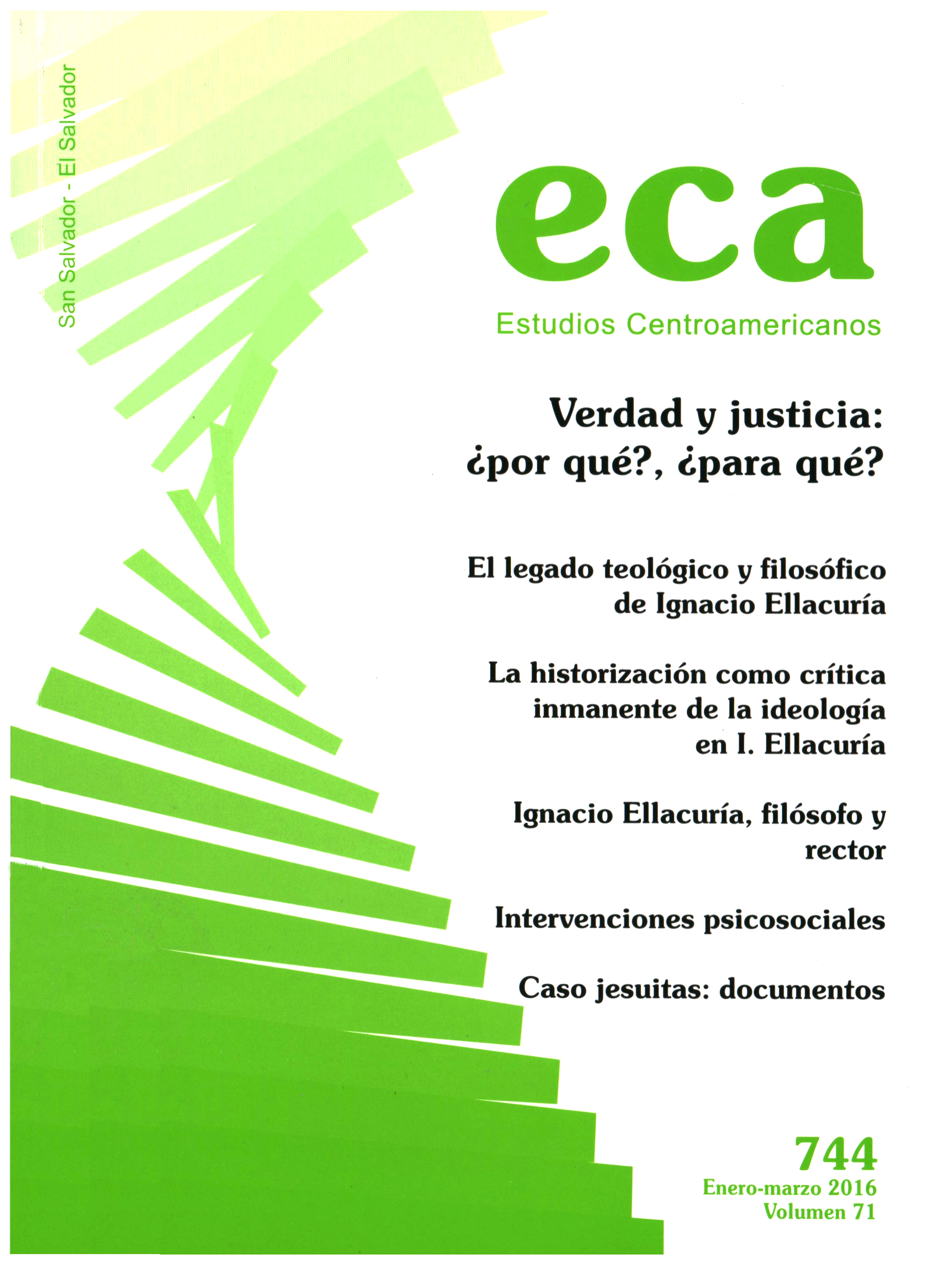
Political theology: prophetism in Latin America. The theological legacy of Ignacio Ellacuría
DOI:
https://doi.org/10.51378/eca.v71i744.3144Keywords:
Philosophy of Historical Reality, Kingdom of God, Utopia, Prophecy, Hope, History, BlochAbstract
Ellacuría’s discourse on utopia and prophecy rests on two foundations: his philosophy of historical reality and his engagement with utopian philosophers—both Bloch’s positive utopia and the Frankfurt School’s negative utopia—and the Bible as an encyclopedia of some of humanity’s most beautiful utopias. Utopia and prophecy not in the abstract, but from a very concrete location, Latin America; from a well-defined social and political standpoint, the popular majorities; and from an ethical imperative, the option for the poor, so as not to fall into falsely universalist discourses. The philosophy of historical reality takes shape in a reflection on the temporal structure of human reality and history, the dynamism of historical processes, and history as a creative process of developing capacities and actualizing historical possibilities. The influence of Zubiri and, above all, of Ernst Bloch is evident. The theological foundations revolve around three major biblical categories: the kingdom of God, utopia, and prophecy, which Ellacuría interprets through an actualizing and active hermeneutic, in a living and fluid dialogue between the texts and historical reality. The result is a vision of a new human being who stands in solidarity with the cause of the oppressed, the new earth understood as a new economic, cultural, and political order, and the new heaven as God’s historical presence among human beings and as the principle of humanity’s ceaseless renewal.
1
Downloads
Published
How to Cite
Issue
Section
License

This work is licensed under a Creative Commons Attribution-NonCommercial-NoDerivatives 4.0 International License.
© ECA. Estudios Centroamericanos está bajo una licencia Creative Commons NonCommercial-NoDerivatives 4.0 International (CC BY-NC-ND 4.0).

La licencia no comercial y sin obra derivada permite la reproducción, distribución y comunicación pública, pero no la posibilidad de comercializar su contenido ni tampoco generar una obra derivada, como una traducción o adaptación, excepto que se pida permiso a los editores de dicha obra.
En ese sentido, se está en la libertad de:
Compartir: copiar y redistribuir el material en cualquier medio o formato.
Bajo las siguientes condiciones:
- Reconocimiento: se debe dar crédito a esta obra de manera adecuada, proporcionando un enlace a la licencia, e indicando si se han realizado cambios.
- Uso no comercial: no se puede hacer uso del material con fines comerciales.
- Sin obra derivada: si se remezcla, transforma o construye sobre ese material, no se puede distribuir el material modificado.

