
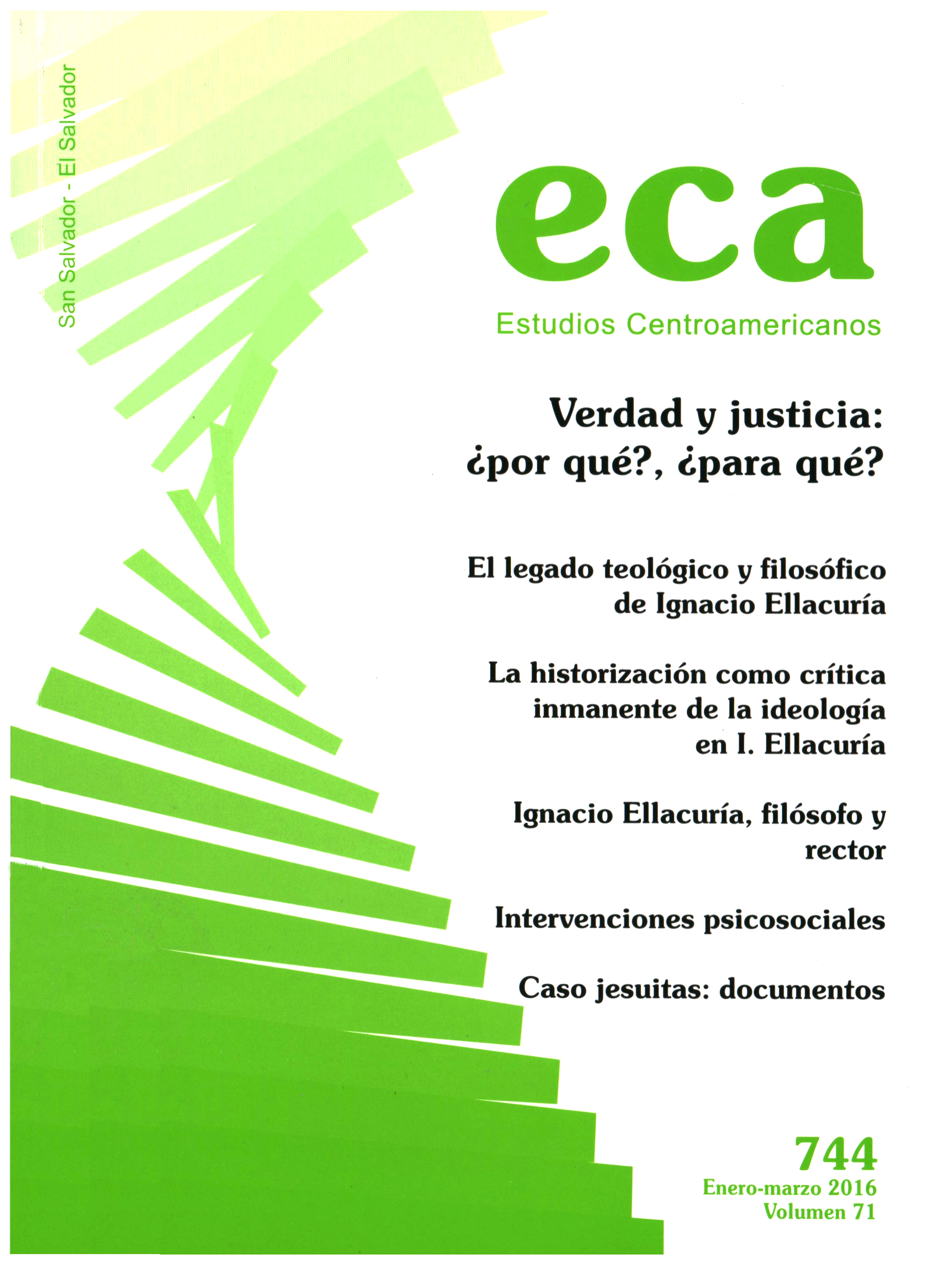
The historicization as an immanent critique of ideology in I. Ellacuría
DOI:
https://doi.org/10.51378/eca.v71i744.3153Keywords:
Political philosophy, Historical context, Critique of ideology, Immanent critiqueAbstract
This article examines the method of historicizing sociopolitical concepts proposed by Ignacio Ellacuría in some of his philosophical and political writings. The thesis it seeks to defend is that Ellacuría’s historicization of concepts constitutes an original version of the critique of ideology developed within the tradition of Western Marxism. Indeed, concepts such as property, the common good, or human rights are historicized by Ellacuría, revealing their ideologized component—that is, their role in concealing and legitimizing relations of oppression and exploitation—as well as their utopian component, the result of past social struggles that imbued these concepts with a transcendent meaning in relation to prevailing asymmetrical social relations. To highlight the specificity and scope of Ellacuría’s historicization, it will be related to both Zubiri’s approaches and those of the Frankfurt School, and it will be argued that it can be understood as a sophisticated form of immanent critique.
1
Downloads
Published
How to Cite
Issue
Section
License

This work is licensed under a Creative Commons Attribution-NonCommercial-NoDerivatives 4.0 International License.
© ECA. Estudios Centroamericanos está bajo una licencia Creative Commons NonCommercial-NoDerivatives 4.0 International (CC BY-NC-ND 4.0).

La licencia no comercial y sin obra derivada permite la reproducción, distribución y comunicación pública, pero no la posibilidad de comercializar su contenido ni tampoco generar una obra derivada, como una traducción o adaptación, excepto que se pida permiso a los editores de dicha obra.
En ese sentido, se está en la libertad de:
Compartir: copiar y redistribuir el material en cualquier medio o formato.
Bajo las siguientes condiciones:
- Reconocimiento: se debe dar crédito a esta obra de manera adecuada, proporcionando un enlace a la licencia, e indicando si se han realizado cambios.
- Uso no comercial: no se puede hacer uso del material con fines comerciales.
- Sin obra derivada: si se remezcla, transforma o construye sobre ese material, no se puede distribuir el material modificado.

