
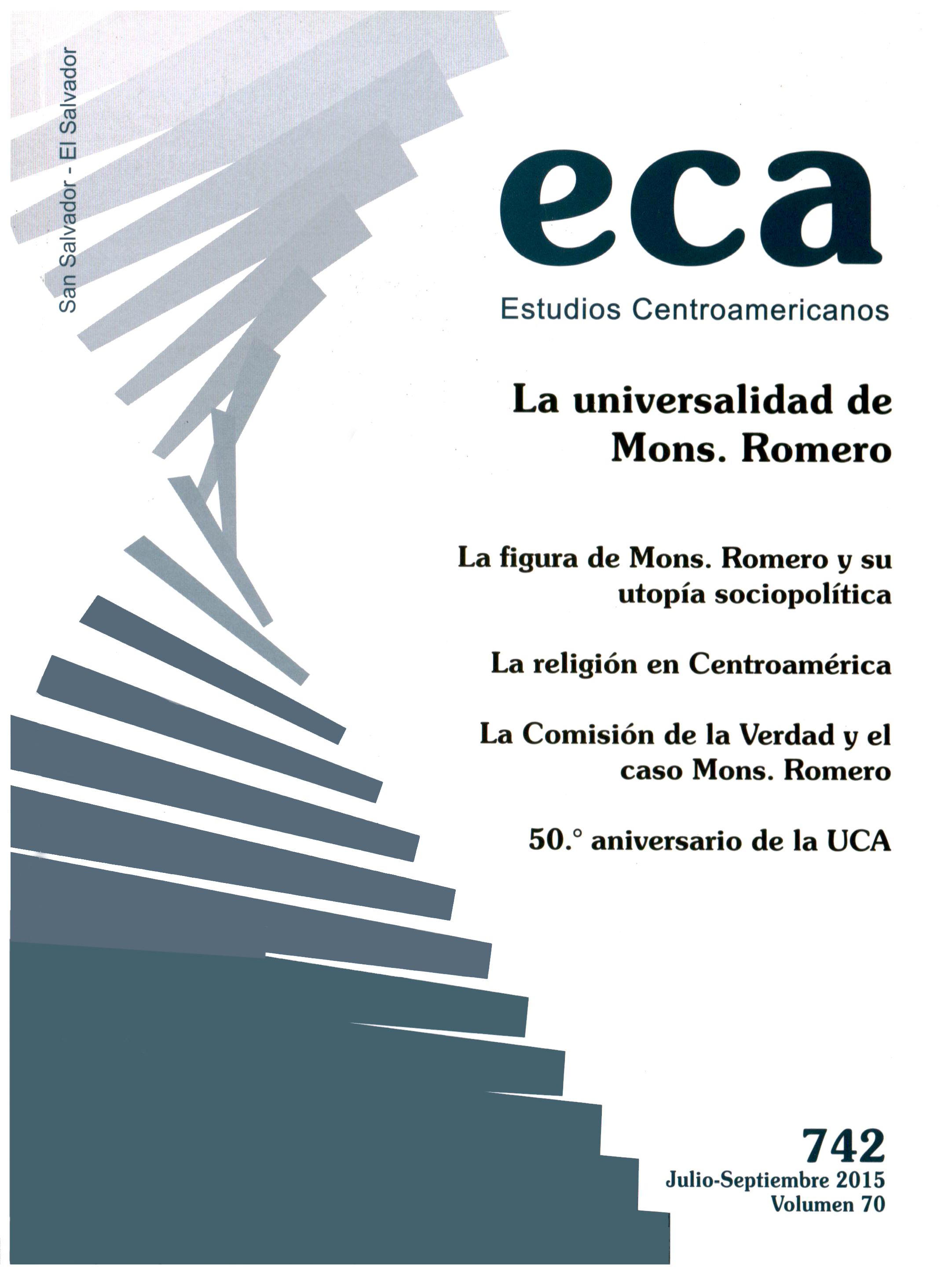
A society according to heart of God: utopia sociopolitical of Mons. Romero
DOI:
https://doi.org/10.51378/eca.v70i742.3336Keywords:
Prophecy, Utopia, Politics, Church, ConversionAbstract
This work introduces, based on Archbishop Romero’s homilies during his first year as head of the Archdiocese of San Salvador (1977), what might be called Archbishop Romero’s sociopolitical utopia, which is encapsulated in the phrase “a society according to God’s heart”—a society that is tranquil, peaceful, beautiful, fraternal, and paradisiacal. The starting point is the insight that there is—in the homilies delivered by Archbishop Romero during his three years as Archbishop of San Salvador, in his pastoral letters, in his diary, in his statements, in his editorials, and so on—a series of expressions and ideas that, when examined systematically, can outline the kind of society he envisioned for Salvadorans. A society that, according to him, God offered to El Salvador as a sign of the historical nature of its salvation and which Archbishop Romero believed in and promoted as God’s plan for Salvadorans. However, such a society would only be possible if Salvadorans first entered into a process of conversion toward God. In Archbishop Romero’s homilies, there are a series of calls for conversion directed at various sectors and social groups. Such conversion must be understood in two ways: ceasing to do what hinders the arrival of that society (ceasing to do what God rejects) and beginning to do what will bring that society into being (doing what God wants). Conversion thus appears as a necessity to break free from the spiral of violence into which the country had fallen. Monsignor Romero was aware that the situation was deteriorating further and further, and that all Salvadorans bore responsibility for this, whether by action or omission. Therefore, to reverse the downward trend, a change in attitudes and behaviors was necessary—a turning toward God. This turning would result in a transformation of social relations. An issue that remains relevant thirty-five years after his martyrdom.
1
Downloads
Published
How to Cite
Issue
Section
License

This work is licensed under a Creative Commons Attribution-NonCommercial-NoDerivatives 4.0 International License.
© ECA. Estudios Centroamericanos está bajo una licencia Creative Commons NonCommercial-NoDerivatives 4.0 International (CC BY-NC-ND 4.0).

La licencia no comercial y sin obra derivada permite la reproducción, distribución y comunicación pública, pero no la posibilidad de comercializar su contenido ni tampoco generar una obra derivada, como una traducción o adaptación, excepto que se pida permiso a los editores de dicha obra.
En ese sentido, se está en la libertad de:
Compartir: copiar y redistribuir el material en cualquier medio o formato.
Bajo las siguientes condiciones:
- Reconocimiento: se debe dar crédito a esta obra de manera adecuada, proporcionando un enlace a la licencia, e indicando si se han realizado cambios.
- Uso no comercial: no se puede hacer uso del material con fines comerciales.
- Sin obra derivada: si se remezcla, transforma o construye sobre ese material, no se puede distribuir el material modificado.

