
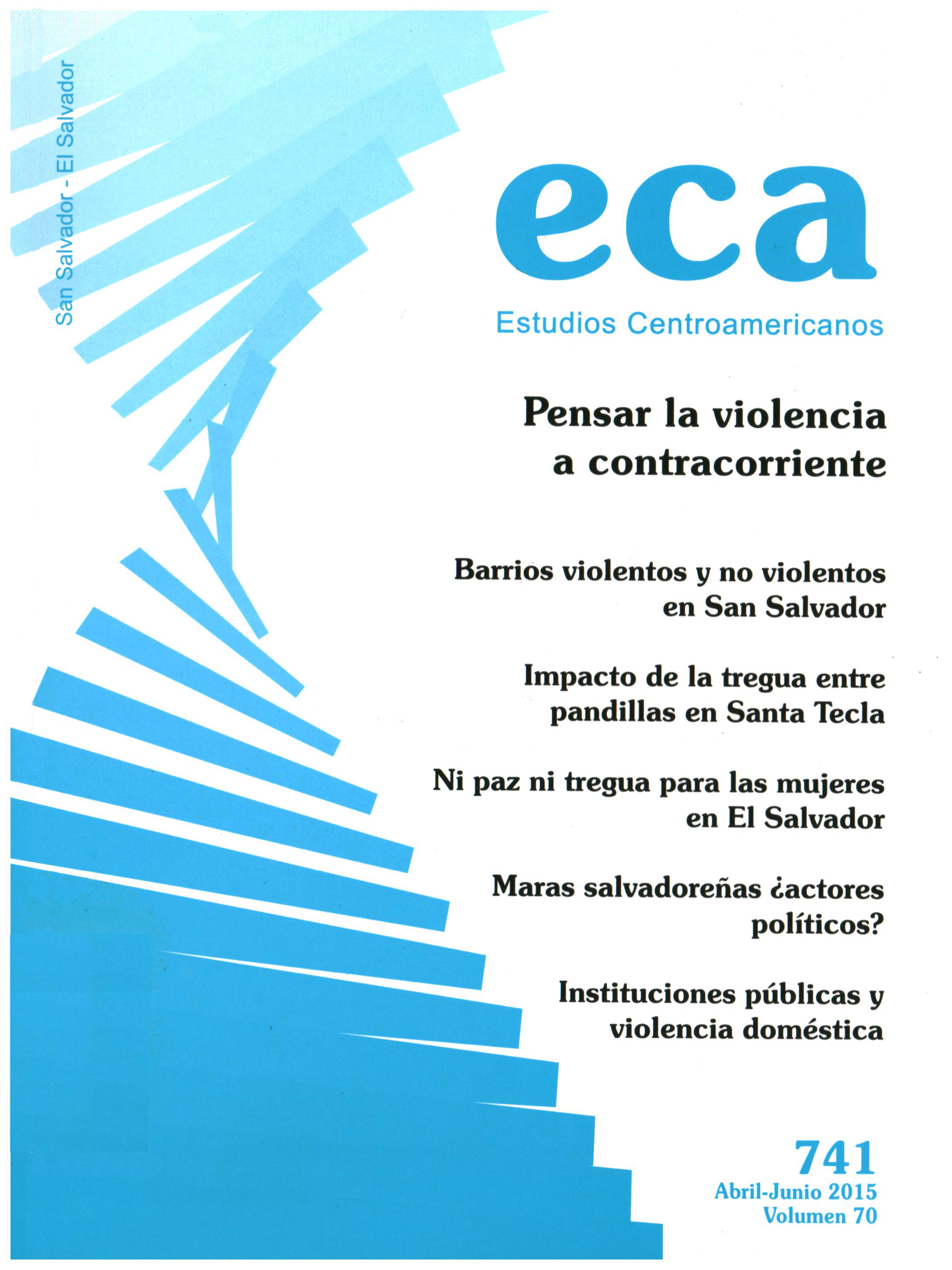
Impact of the truce between gangs in life daily life in a municipality free from violence: the case by Santa Tecla
DOI:
https://doi.org/10.51378/eca.v70i741.3312Keywords:
El Salvador, Gangs, Violence, Truce, Daily lifeAbstract
Youth gangs, or maras, are one of the main causes of violence in El Salvador. After various repressive state measures to counter them failed, the government decided in 2012 to support a process called “the truce.” This consisted of an agreement between the two main gangs to reduce crime in exchange for the state easing pressure on gang members and their families and establishing reintegration programs. At the local level, the process took shape with the creation of so-called “violence-free municipalities,” which were areas where local authorities promoted and supported the pact through preventive measures. This text investigates the impact of the truce on the territory and the daily lives of the residents of one of these municipalities, Santa Tecla, with an emphasis on the communities of San Rafael and San José El Pino, which have a high presence of one of the two maras (MS-13). It also delves into the perceptions of members of both communities and the rest of the municipality regarding the truce and the role that gangs play in this process.
1
References
Argueta, S. (1991). “Diagnóstico de los grupos de pandillas llamados maras en San Salvador”. En Revista de Psicología de El Salvador, 2(43): 53-84.
Aguilar, J. (2006): “Los resultados contraproducentes de las políticas antipandillas”. ECA, 62(708): 877-890.
COAMSS and OPAMSS (2009). Fortalecimiento institucional en el AMSS para la cohesión social y seguridad ciudadana. San Salvador.
Cohen, Stanley (1985). Visiones del control social. Barcelona: Ediciones PPU.
Cruz, J. M., Carranza, M., and Santacruz, M. L. (2004). “El Salvador. Espacios públicos, confianza interpersonal y pandillas”. En ERIC, IDESO, IDIES e IUDOP (eds.). Maras y pandillas en Centroamérica. Pandillas y capital social. Vol. 2. San Salvador. UCA Editores.
Cruz, J. M. (2005). “Los factores asociados a las pandillas juveniles en Centroamérica”. Estudios Centroamericanos (ECA), 685(686): 1155-1182.
Carranza, M. (2004). “Políticas juveniles y rehabilitación de mareros en El Salvador”. En ERIC, IDIES, IUDOP, NITLAPANDIRINPRO (eds.). Maras y pandillas en Centroamérica: políticas juveniles y rehabilitación, Volumen III. Managua: UCA Publicaciones.
Dudley, S. and Pachico, E. (2013). “El Salvador’s Gang Truce: Positives and Negatives”. INSIGHT.
Interpeace. (2014). Ilopango, un año después. Comunidad, pandillas y reducción de la violencia. Guatemala: Interpeace.
Interpeace. (2014). Santa Tecla: a fertile ground to reduce violence. Guatemala: Interpeace.
Iñiguez, J. (2007). “Las maras, un problema sobredimensionado”. En Valenzuela, J., Nateras, A., Reguillo, R. (2007). Las maras: identidades juveniles al límite. México: Universidad Autónoma Metropolitana. En American Journal of Sociology. 81(1): [URL: http://www.catedras.fsoc.uba.ar/pegoraro/Materiales/Janowitz_Teoria_Social_Control_Social.PDF] (20/11/2014)
Lund, Christian. (2006). “Twilight Institutions: Public, and Local Politics in Africa”. En Development and Change 37(4): 685-705.
Marroquín, A. y Vásquez, O. (2014). “Entre gritos y silencios. La narrativa de la prensa salvadoreña sobre la tregua entre pandillas”. Revista Nueva Sociedad 249, Eeerofebrero 2014. [URL http://nuso:.org/articulo/entre-gritos-y-silencios-la-narrativa-de-laprensa-salvadorena-sobre-la-tregua-entrepandillas/] (25/07/2014)
Martel, R. (2007). “Las maras: nuevas formas de espanto y control social”. En Valenzuela, J., Nateras, Alfredo y Reguillo, R. (2007). Las maras: identidades juveniles al límite. México: Universidad Autónoma Metropolitana.
Martel, R. and Marroquín, A. (2007). “Indiferencias y espantos. Relatos de los jóvenes de pandillas en la prensa escrita de Centroamérica”. En Rey, G. (2007) Los relatos periodísticos del crimen. Bogotá: Centro de Competencia en Comunicación para América Latina. [URL: http://www.academia.edu/195962/Indiferencias_y_espantos._Relatos_de_los_jovenes_de_pandillas_en_la_prensa_escrita_de_Centroamerica] (25/07/2014)
Morales, J. (2011). “Propuesta analítica de cinco tesis interpretativas de la violencia estructural y el ejercicio de gobernabilidad en material de gestión de seguridad pública y prevención de la violencia en municipio de Santa Tecla”. Revista Policía y Seguridad Pública. 1(1): 43-129
Meagher, K. (2012). “The Strength of Weak States? Non-State Security Forces and Hybrid Governance in Africa”. En Development and Change, 43(5): 1073–1101
Santacruz, M. and Concha-Eastman, A. (2001). Barrio adentro. La solidaridad violenta de las pandillas. San Salvador. IUDOP-UCA/OPS.
Santacruz, M. L. and Cruz, J. M. (2001). “Las maras en El Salvador”. In ERIC IDESO, IDIES e IUDOP (comp.). Maras y pandillas en Centroamérica, vol. 1. Managua: UCA Publicaciones.
Pegoraro, Juan. (2001). “Inseguridad y violencia en el marco del control social”. Espacio Abierto, julio-septiembre, 10(3). En Cuaderno Venezolano de Sociología. 349-372.
Schlichte, Klaus. (2009). In the Shadow of Violence. Chicago: University of Chicago Press
Schmelzle, Cord. (2011). “Evaluating Governance. Effectiveness and Legitimacy”. En Areas of Limited Statehood. SFB-Governance Working Paper Series, n.º 26, Berlín: Research Center (SFB).
Rivando, C. (2013). Gangs in Central America. Washington: Congressional Research Service.
Rodgers, D. (1999). Youth Gangs and Violence in Latin America and the Caribbean: A Literature Survey. Washington: The World Bank.
Tager, A. and Aguilar, I. (2013). La tregua entre pandillas salvadoreñas, hacia un proceso de construcción de paz social. Guatemala: Interpeace.
Thrasher, F. (1927). The Gang: a Study of 1313 Gangs in Chicago. Chicago: University of Chicago Press.
UNDP. (2004). El debate conceptual sobre la democracia. Nueva York: PNUD.
Prensa
CoLatino. (2014). “Somos un país violento desde siempre: René Martínez”. [URL: http://nuevaweb.diariocolatino.com/somosun-pais-violento-desde-siempre-renemartinez/] (15/07/2014)
El Faro. (2012). “El origen del odio”. Disponible en: [URL: http://www.salanegra.elfaro.net/es/201208/cronicas/9301/] (16/07/2014)
El Faro. (2013). “La tregua entre pandillas o el Estado en conflicto con la ley”. [URL: http://www.elfaro.net/es/201303/noticias/11225/]
(16/07/2014)
El Faro. (2012). “Gobierno negoció con pandillas reducción de homicidios”. [URL: http://www.elfaro.net/es/201203/noticias/7985/] (16/07/2014)
El Faro. (2014). “El Gobierno se deshará de la palabra tregua pero seguirá dialogando con las pandillas”. [URL: http://www.salanegra.elfaro.net/es/201406/entrevistas/15535/] (20/08/2014)
El Faro. (2015). “Gobierno propone becas y créditos para pandilleros que se retiren”. [URL: http://www.elfaro.net/es/201504/
efradio/16918/28abr15%7C-Gobiernopropone-becas-y-cr%C3%A9ditos-para-pandilleros-que-se-retiren.htm ]
(07/05/2015)
La Prensa Gráfica. (2014). “Gobierno dice que no va a continuar con la tregua”. [URL:http://www.laprensagrafica.com/2014/06/13/gobierno-dice-que-no-va-a-continuar-con-la-tregua] (20/08/2014)
La Prensa Gráfica. (2013). “PYMES pagan 18 millones al año en extorsiones”. [URL: http://www.laprensagrafica.com/2013/09/03/pymes-pagan-18-millones-al-ano-en-extorsiones] (15/07/2014)
Downloads
Published
How to Cite
Issue
Section
License

This work is licensed under a Creative Commons Attribution-NonCommercial-NoDerivatives 4.0 International License.
© ECA. Estudios Centroamericanos está bajo una licencia Creative Commons NonCommercial-NoDerivatives 4.0 International (CC BY-NC-ND 4.0).

La licencia no comercial y sin obra derivada permite la reproducción, distribución y comunicación pública, pero no la posibilidad de comercializar su contenido ni tampoco generar una obra derivada, como una traducción o adaptación, excepto que se pida permiso a los editores de dicha obra.
En ese sentido, se está en la libertad de:
Compartir: copiar y redistribuir el material en cualquier medio o formato.
Bajo las siguientes condiciones:
- Reconocimiento: se debe dar crédito a esta obra de manera adecuada, proporcionando un enlace a la licencia, e indicando si se han realizado cambios.
- Uso no comercial: no se puede hacer uso del material con fines comerciales.
- Sin obra derivada: si se remezcla, transforma o construye sobre ese material, no se puede distribuir el material modificado.

