
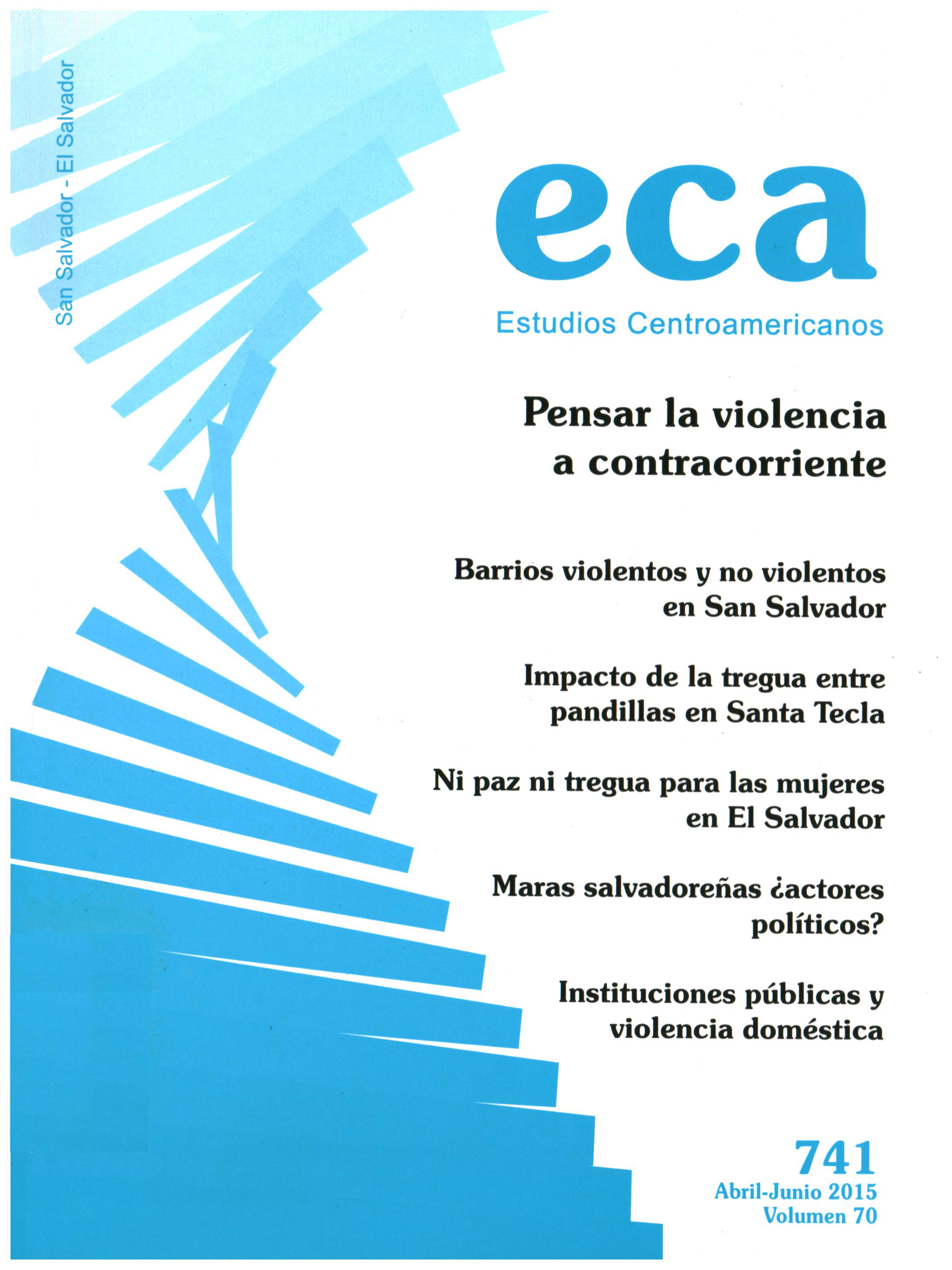
No Peace, No Truce for Women in El Salvador: A Study on the Meaning of Domestic Violence from Women’s Perspectives in One of San Salvador’s Many Invisible Communities
DOI:
https://doi.org/10.51378/eca.v70i741.3313Keywords:
Violence against women, Domestic violence, Reasons, Proximity to violence, Perceptions, Gang truceAbstract
In a country where violence has become part of everyday life for its citizens, certain forms of violence are silenced by the overwhelming weight of this social context. In particular, violence against women appears to have been rendered invisible by the significance and sheer number of violent deaths among men and by gang violence. Thus, this issue has historically received little attention in the dominant social and political discourses at the national level. Given this gap, the focus of this research is to understand how women perceive and react to their experiences of domestic violence in a community with high rates of violence (of all kinds) in El Salvador. By engaging with women who have experienced violence and using in-depth interviews, the study sought to explain how these experiences are understood in a small, marginalized community in the San Salvador metropolitan area, and how women who experience violence explain, justify, and respond to these realities. At the same time, the study explored how the community and political context influences the way these realities are viewed in El Salvador.
3
References
Atkinson, R. y Flint, J. (2001). Accessing Hidden and Hard-to-Reach Populations: Snowball Research Strategies. Social Research Update, Department of Sociology, University of Surrey, England.
Alto Comisionado para los Derechos Humanos, Oficina Regional para América Central (2011): “Violencia contra las mujeres en El Salvador. Observaciones y recomendaciones de los Órganos de Tratado, Procedimientos Especiales y Examen Periódico Universal”.
Bourdieu, P. (2001). Masculine Domination. Cambridge: Polity Press.
Comité de América Latina y el Caribe para la Defensa de los Derechos de la Mujer (Cladem). (2007). Monitoreo sobre violencia sexual en conflicto armado. En Colombia, El Salvador, Guatemala, Honduras, Nicaragua y Perú. Primera edición Lima, Perú, diciembre 2007, Biblioteca Nacional del Perú, n.° 2007-13575.
Cockburn, C. (2004). “The continuum of violence: a gender perspective on war and peace”. En Giles, W. and Hyndman, J. (editors), Sites of Violence: Gender and Conict Zones. Berkeley: University of California Press, pp. 24-44.
Heise, L. (1998). “Violence Against Women: an Integrated, Ecological Framework”. Violence Against Women, 4, pp. 262-290.
Hume, M. (2012). “Never truly defeated: challenging the impunity of violence against women in Central America”. Irish Migration Studies in Latin America, 8 (1). pp. 46-58.
________ (2009). “The Politics of Violence: Gender, Conflict and Community in El Salvador”. Series: Bulletin of Latin American research book series. Wiley- Blackwell, Chichester.
________ (2009b). “Researching the gendered silences of violence in El Salvador”. IDS Bulletin, 40 (3), pp. 78-85. ISSN 0265-5012 (doi:10.1111/j.1759-5436.2009.00042.x).
________ (2004). “It›s as if you don›t know, because you don›t do anything about it›: gender and violence in El Salvador”. Environment and Urbanization, 16 (2). pp. 63-72. ISSN 0956-2478(doi:10.1177/095624780401600223).
Imbush, P. (2003). “The concept of violence”. En: Heitmeyer, Wilhelm and John Hagan (Hg.). International handbook on violence research (13-39). Netherlands: Kluwer Academic Publishers.
Instituto Universitario de Opinión Pública de la Universidad Centroamericana José Simeón Cañas,(Iudop-UCA). (201o). “Segundos en el aire”: mujeres pandilleras y sus prisiones. Primera edición: julio de 2010. Impreso en los Talleres Gráficos UCA. San Salvador, El Salvador.
Instituto Salvadoreño para el Desarrollo de la Mujer (Isdemu). (2011). Segundo informe nacional sobre la situación de violencia contra las mujeres en El Salvador, 2010. Un Problema de Seguridad Pública. San Salvador: ISDEMU.
_____ (2012). Informe nacional sobre el estado y situación de la violencia contra las mujeres en El Salvador. San Salvador: Isdemu.
Jost, J. y Major, B. (2001). The psychology of legitimacy: emerging perspectives on ideology, justice, and intergroup relations. Cambridge: University Press.
Kalmuss, D. y Murray, A. (1982). “Wife’s Marital Dependency and Wife Abuse”. Journal of Marriage and Family, vol. 44, n.° 2, pp. 277-286.
Kelman, H. (2001). “Reflections on Social and Psychological Processes of Legitimization and Delegitimization”. From J.T. Jost and B. Major (eds.), The psychology of legitimacy: emerging perspectives on ideology, justice, and intergroup relations. Cambridge: University Press.
Komter, Aafke. (1989). “Hidden Power in Marriage”. Gender and Sociedty, vol. 3, n.° 2, pp. 187-216.
Landa Urgarte, A. y Herrera Argueta M. (2011). Historias de mujeres víctimas de feminicidio: mujeres que trataron de salir del ciclo de la violencia y dominación. Primera edición, San Salvador: Isdemu.
Liu, M. y Chan, C. (1999). “Enduring Violence and Staying in Marriage: Stories of Battered Women in Rural China”, Violence Against Women 1999 (5): 1469, DOI:10.1177/10778019922183471
Kelly J. y Johnson M. (2008). “Differentiation among types of intimate partner violence: research update and implications for interventions”.
Family court review, vol. 46, n.°3, 476–499.
Piispa, M. (2002). “Complexity of Patterns of Violence Against Women in Heterosexual Partnerships”, in Violence Against Women 2002 8: 873, DOI: 10.1177/107780102400388515.
ORMUSA (2014). “Feminicidios de pareja en aumento”. En La Boletina de ORMUSA, n ° 5. Observatorio de violencia de género contra las mujeres.
Ramisetty A. y Muriu M. (2013). “‘When does the end begin?’ Addressing gender based violence in post-conflict societies: case studies from Zimbabwe and El Salvador”, Gender & Development, 21:3, 489-503, DOI: 10.1080/13552074.2013.846642.
Rusbult, C. y Martz, J. (1995). “Remaining in an Abusive Relationship: an Investment Model Analysis of Nonvoluntary Dependence”. In Personality and Social Psychology Bulletin 21:558 DOI: 10.1177/01467295216002.
Yoshioka, M. y Choi, D. (2005). “Culture and Interpersonal Violence Research: Paradigm Shift to Create a Full Continuum of Domestic Violence Services”, in Journal Interpersonal Violence 20: 513, DOI: 10.1177/08862605042677 58.
Yount, K. y Li, L. (2009). “Women’s ‘Justification’ of Domestic Violence in Egypt”. Journal of Marriage and Family 71: 1125 – 1140.
Villalobos, J. (2012). “Violence in Central America”. In Rethinking the “War on Drugs” through the US-MEXICO Prism. Yale Center for the Study of Globalization.
United Nations Office on Drugs and Crime, UNODC (2012). 2011 Global Study on Homicide, Trend, context and data. Available in: http://www.unodc.org/documents/data-and-analysis/statistics/Homicide/Globa_study_on_homicide_2011_web.pdf
Downloads
Published
How to Cite
Issue
Section
License

This work is licensed under a Creative Commons Attribution-NonCommercial-NoDerivatives 4.0 International License.
© ECA. Estudios Centroamericanos está bajo una licencia Creative Commons NonCommercial-NoDerivatives 4.0 International (CC BY-NC-ND 4.0).

La licencia no comercial y sin obra derivada permite la reproducción, distribución y comunicación pública, pero no la posibilidad de comercializar su contenido ni tampoco generar una obra derivada, como una traducción o adaptación, excepto que se pida permiso a los editores de dicha obra.
En ese sentido, se está en la libertad de:
Compartir: copiar y redistribuir el material en cualquier medio o formato.
Bajo las siguientes condiciones:
- Reconocimiento: se debe dar crédito a esta obra de manera adecuada, proporcionando un enlace a la licencia, e indicando si se han realizado cambios.
- Uso no comercial: no se puede hacer uso del material con fines comerciales.
- Sin obra derivada: si se remezcla, transforma o construye sobre ese material, no se puede distribuir el material modificado.

