
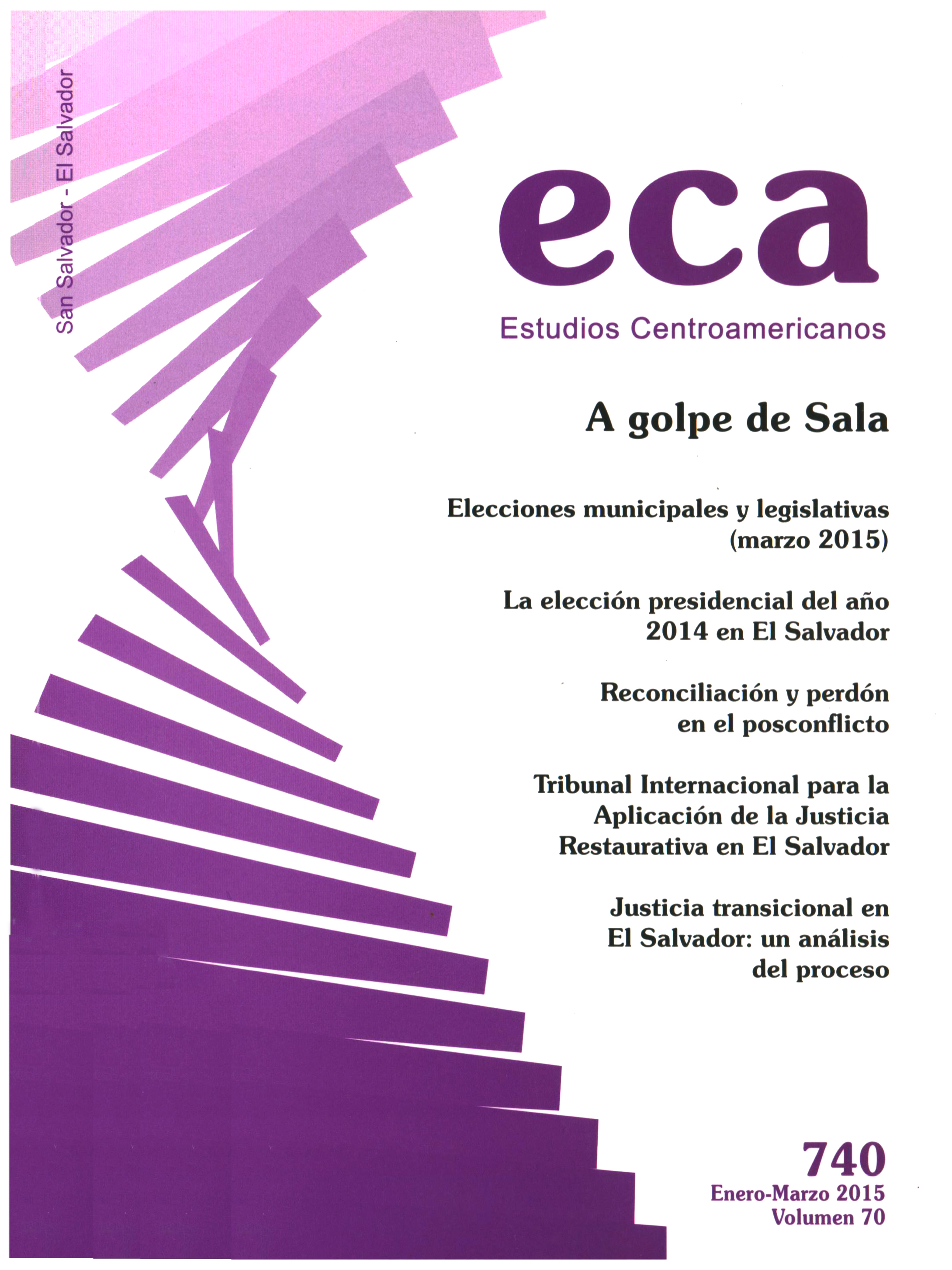
The experience of the International Tribunal for the Application of Restorative Justice in El Salvador (2009-2015): reflections after a singular path towards the establishment of public policies of restoration and national reconciliation
DOI:
https://doi.org/10.51378/eca.v70i740.3217Keywords:
Reparations, Human rights violation, Justice AdministrationAbstract
Drawing on his experience as a member of the Tribunal of El Salvador, now in its seventh session, the author argues that Salvadoran victims of serious human rights violations and crimes against humanity are asking us for closeness, for a connection to their lives, for social recognition, truth, justice, and reparations. This demand requires us to foster spaces for shared encounter where we can discuss ethical dilemmas and moral anguish, as well as places where the pain of those who continue to suffer can be expressed and felt. For this reason, the Tribunal emerges as an initiative from civil society, specifically from Idhuca and the Network of Salvadoran Victims’ Committees, and thus derives its legitimacy from the victims’ own demands and the need to complement the work of the Truth Commission—a demand that arises within a context of absolute impunity and the complete ineffectiveness of the administration of justice.
1
Downloads
Published
How to Cite
Issue
Section
License

This work is licensed under a Creative Commons Attribution-NonCommercial-NoDerivatives 4.0 International License.
© ECA. Estudios Centroamericanos está bajo una licencia Creative Commons NonCommercial-NoDerivatives 4.0 International (CC BY-NC-ND 4.0).

La licencia no comercial y sin obra derivada permite la reproducción, distribución y comunicación pública, pero no la posibilidad de comercializar su contenido ni tampoco generar una obra derivada, como una traducción o adaptación, excepto que se pida permiso a los editores de dicha obra.
En ese sentido, se está en la libertad de:
Compartir: copiar y redistribuir el material en cualquier medio o formato.
Bajo las siguientes condiciones:
- Reconocimiento: se debe dar crédito a esta obra de manera adecuada, proporcionando un enlace a la licencia, e indicando si se han realizado cambios.
- Uso no comercial: no se puede hacer uso del material con fines comerciales.
- Sin obra derivada: si se remezcla, transforma o construye sobre ese material, no se puede distribuir el material modificado.

