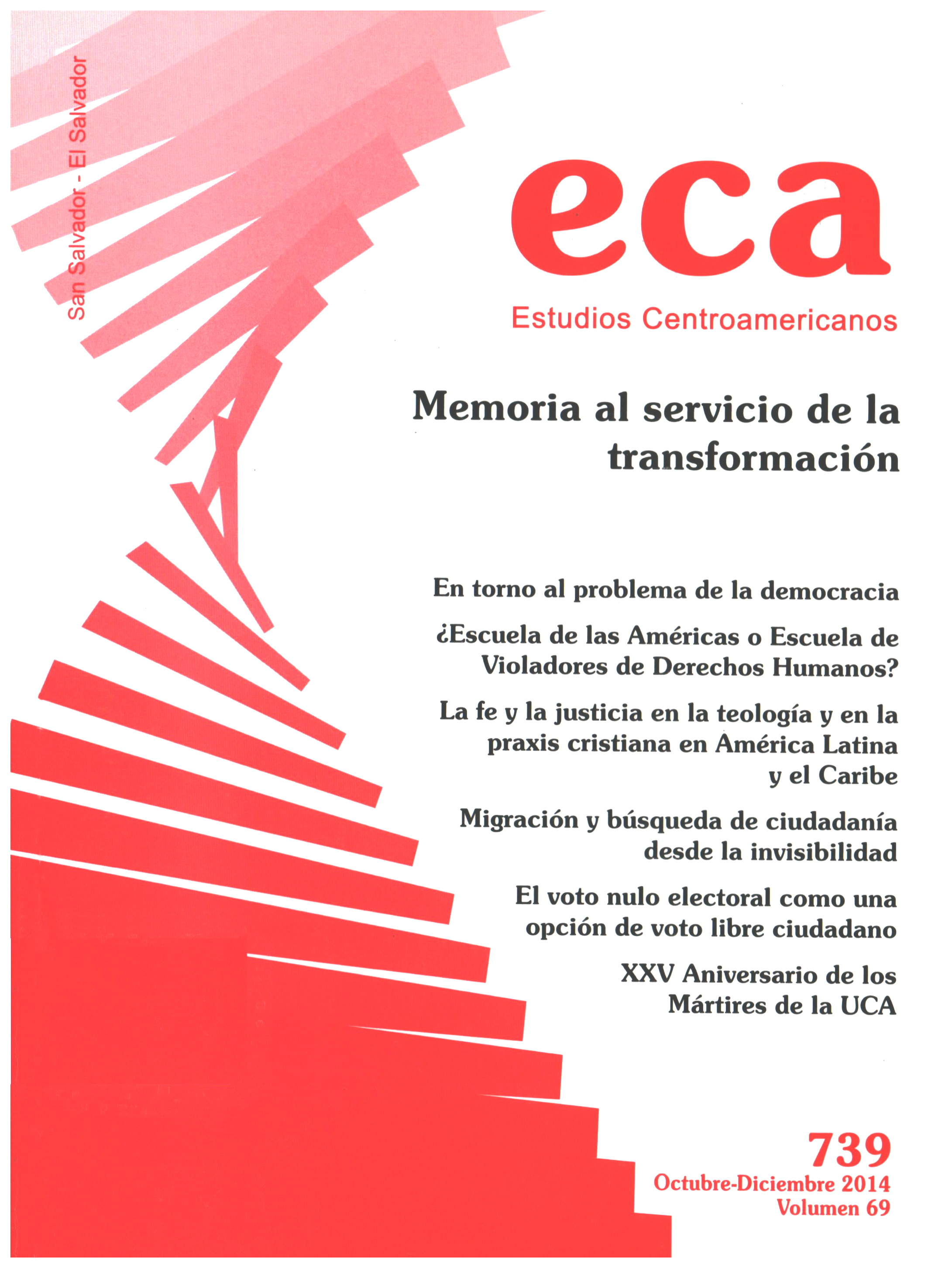
School of the Americas or school for human rights violators?
DOI:
https://doi.org/10.51378/eca.v69i739.3223Keywords:
State terrorism, Militarism, Hegemony, Foreign policy, Dictatorship, Ideology, International anarchy, Structural realism, Geopolitics, National security, International human rightsAbstract
The School of the Americas (SOA) was established by the United States in 1946 at one of its military bases in Panama. According to its founders, the SOA’s primary objective was to professionalize the armed forces of Latin American countries. However, Washington’s true purpose was to secure its dominance over the subcontinent through the anti-communist indoctrination of these armed forces, supplemented by training in military brutality. The SOA was created as yet another tool of Washington’s geopolitical strategy to maintain its hemispheric hegemony. Control of these armed forces allowed the White House to minimize the deployment of its own troops to crush social unrest in its self-proclaimed “backyard.” This article will focus on the impact of the SOA in El Salvador, particularly during the period from 1980 to 1992.
1
References
Armstrong, D. et. al. (2007). International Law and International Relations. Cambridge: Cambridge University Press.
Brands, H. W. (1998). What America Owes the World: The Struggle for the Soul of Foreign Policy. Cambridge: Cambridge University Press.
Castellanos, J. M. (2001). El Salvador 1930- 1960: Antecedentes históricos de la guerra civil. San Salvador: Consejo Nacional para la Cultura y el Arte.
Cohen, W. I. (1993). The Cambridge History of American Foreign Relations: America in the Age of Soviet Power, 1945-1991, vol. IV. Cambridge: Cambridge University Press.
Crandall, R. C. (2008). The United States and Latin America After the Cold War. Cambridge: Cambridge University Press.
CRS Report for Congress, “Instances of Use of United States Armed Forces Abroad, 1798- 2001”, Richard F. Grimmett, Specialist in National Defense, Foreign Affairs, Defense, and Trade Division, Order Code RL30172, Congressional Research Service, The Library of Congress.
Fossum, E. (1967). “Factors Influencing the Occurrence of Military Coups D’Etat in Latin America”. Journal of Peace Research, vol. 4, n. º 3, pp. 228-251.
Greenberg, A. S. (2005). Manifest Manhood and the Antebellum American Empire. Cambridge: Cambridge University Press.
Harper, J. L. (2004). American Machiavelli: Alexander Hamilton and the Origins of U.S. Foreign Policy. Cambridge: Cambridge University Press.
Hawkins, M. (1997). Social Darwinism in European and American Thought, 1860- 1945: Nature as model and nature as threat. Cambridge: Cambridge University Press.
Hennelly, M. J. (1993). “US Policy in El Salvador: Creating Beauty or the Beast?”. Parameters, Spring 1993, pp. 59-69, Department of Social Sciences, US Military Academy (US Army War College).
Hitchins, C. (2001). The Trial of Henry Kissinger. London: Verso Press.
Hoff, J. (2008). A Faustian Foreign Policy: From Woodrow Wilson to George W. Bush – Dreams of Perfectibility. Cambridge: Cambridge University Press.
LeoGrande, W. M. and Robbins, C. A. (1980). “Oligarchs and Officers: The Crisis in El Salvador”. Foreign Affairs, vol. 58, n.° 5 (Summer, 1980), pp. 1084-1103).
Little, R. (2007). The Balance of Power in International Relations: Metaphors, Myths and Models. Cambridge: Cambridge University Press.
Maragall, E. de M. (1992). Diccionario manual de la lengua española. Barcelona: BIBLIOGRAF S/A.
Meiertons, H. (2010). The Doctrine of US Security Policy: An Evaluation under International Law. Cambridge: Cambridge University Press.
Pach, C. (2006). “The Reagan Doctrine Principle, Pragmatism, and Policy”. Presidential Studies Quarterly, vol. 36, n. º 1, Presidential Doctrines, pp. 75-88.
Peceny, M. and Stanley, W. D. (2010). “Counterinsurgency in El Salvador”. Politics & Society, vol. 38, pp. 67-94.
Rogers, W. D. (1984). “The United States and Latin America”. Foreign Affairs, vol. 63, n.º 3, America and the World 1984, pp. 560-580.
Sanchez, P. M. (2003). “Bringing the International Back In: US Hegemonic Maintenance and Latin America’s Democratic Breakdown in the 1960’s and 1970’s”. International Politics, vol. 40, Issue 2, pp. 221-247.
Sandos, J. A. (1973). “U.S. Military Policy Toward Latin America”. World Affairs, vol. 135, n. º 4, pp. 293-308.
Schoenbaum, T. J. (2006). International Relations - The Path Not Taken: Using International Law to Promote World Peace and Security. Cambridge: Cambridge University Press.
SOA Watch (School of the Americas Watch http://www.soaw.org/).
Stuart, G. H. (2nd ed.) (1928). Latin America and The United States. New York: The Century Co.
Tannenbaum, F. (1961). “The United States and Latin America”. Political Science Quarterly, vol. 76, n. º 2, pp. 161-180.
The National Archives, Condolences from Jimmy Carter – Murder of Archbishop Óscar Arnulfo Romero. Recuperado de: http://gwu.edu/~nsarchiv/.
The National Security Archives, Document 1, Department of State, Report to Kissinger, SECRET, ‘The Third World War and South America’, August 3, 1976. Recuperado de: http://www.gwu.edu/~nsarchiv/NSAEBB/NSAEBB416/
The National Security Archives, Document 3, CIA, SECRET, ‘A brief look at Operation Condor’, August 22, 1978. Recuperado de: http://www.gwu.edu/~nsarchiv/NSAEBB/NSAEBB416/
The National Security Archives, ‘The Iran- Contra Affair 20 Years On’, Declassified on November 24, 2006. Recuperado de: http://www.gwu.edu/~nsarchiv/NSAEBB/NSAEBB210/index.htm
The United States Department of Justice (2012), Executive Office for Immigration Review, Immigration Court, Orlando, Florida, In the matter of: Carlos Eugenio VIDES CASANOVA (Respondent), In Removal Proceedings.
US Department of State, FOIA (Freedom Of Information Act), (1980), “Status report on the State Department’s efforts to encourage
Vatican Officials to try to influence Salvador’s Archbishop Romero to support moderate change through the new Junta”. Recuperado de: http://foia.state.gov/Search/Results.aspx?collection=ELSALVADOR&searchText=*
US State Department, Search for: National Security Study Directives (NSSD). Recuperado de: http://www.state.gov/
Vincent, R. J. (ed.) (1986). Foreign Policy and Human Rights: Issues and Responses. Cambridge: Cambridge University Press.
Downloads
Published
How to Cite
Issue
Section
License

This work is licensed under a Creative Commons Attribution-NonCommercial-NoDerivatives 4.0 International License.
© ECA. Estudios Centroamericanos está bajo una licencia Creative Commons NonCommercial-NoDerivatives 4.0 International (CC BY-NC-ND 4.0).

La licencia no comercial y sin obra derivada permite la reproducción, distribución y comunicación pública, pero no la posibilidad de comercializar su contenido ni tampoco generar una obra derivada, como una traducción o adaptación, excepto que se pida permiso a los editores de dicha obra.
En ese sentido, se está en la libertad de:
Compartir: copiar y redistribuir el material en cualquier medio o formato.
Bajo las siguientes condiciones:
- Reconocimiento: se debe dar crédito a esta obra de manera adecuada, proporcionando un enlace a la licencia, e indicando si se han realizado cambios.
- Uso no comercial: no se puede hacer uso del material con fines comerciales.
- Sin obra derivada: si se remezcla, transforma o construye sobre ese material, no se puede distribuir el material modificado.

