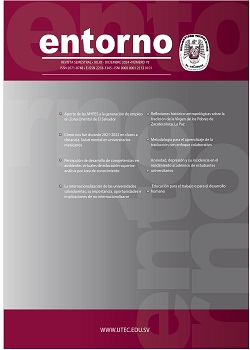
The internationalization of Salvadoran universities: importance, opportunities and implications
DOI:
https://doi.org/10.5377/entorno.v1i78.18431Keywords:
Universities, El Salvador, Agreements, Globalization, Quality in education, Competencies in education, Strategic alliances (Education), Higher educationAbstract
This study focuses on the relevance universities acquire when student exchange programs, study abroad programs, and learning abroad experiences for students, faculty and researchers are carried out. In addition to these, it also focuses on the academic opportunities that open up, for both the university and their staff, and to promote the generation of scientific, technological, sociocultural, and innovative knowledge in all the departments of the University. The importance of internationalizing universities was identified, specifically that of Universidad Francisco Gavidia (UFG, given its Spanish acronym), Universidad Centroamericana “José Simeón Cañas” (UCA, Spanish acronym) and Universidad de El Salvador (UES, Spanish acronym), where those in charge of the internationalization processes were interviewed. This qualitative-quantitative research was conducted using bibliographical references on the work carried out by some Salvadoran and foreign universities on internationalization: its importance, opportunities and challenges. In addition, an online survey was administered to a random sample of 165 full-time professors, associate professors, students, professionals, and high school graduates. The survey confrmed the relevance of recognition; the cornerstone for a career and a university degree is to have more international prestige. Important aspects and benefts that a university has when internationalizing were asked, such as do you know what the internationalization of universities refers to? What are the most important benefts of the internationalization of the university where you study or studied? What are the disadvantages of a university when it does not internationalize? Based on the results of this research, it has been concluded that universities must have an International Relations Office; a reengineering must be carried out where new opportunities with other countries, regions and universities should be sought after with the purpose of increasing prestige and quality in the teaching-learning process. The Ministerio de Educación, Ciencia y Tecnología (Ministry of Education, Science and Technology, MINEDUCYT, given its Spanish acronym) proposed a Model for the Internationalization of Higher Education in El Salvador, being this an important constituent in the strategic plans of the universities.
Downloads
280
Downloads
Published
How to Cite
Issue
Section
License
Copyright (c) 2024 Universidad Tecnológica de El Salvador

This work is licensed under a Creative Commons Attribution-NonCommercial-ShareAlike 4.0 International License.
© Entorno
It is required that the authors transfer the right of re-production of their articles to the Entorno Journal

