
Established in 2011 and hosted by Ubiquity.
Managed by Mongolian Academy of Sciences.
This website supports the online publication of Mongolian journals. For more information about MongoliaJOL and how to join the service see the About page.
The journal is aimed at the national and international scientific academic community: professionals, teachers, researchers, students and people from society who are interested in university scientific production. To send the articles, whose content is the exclusive responsibility of their authors, consult the publication rules included at the end of each issue of the journal at https://bit.ly/2HRrW3T and write to editorial@uees.edu.sv or norma.hernandez@uees.edu.sv
Publication rules
The journal of research, innovation and technology in health Crea Science of the Evangelical University of El Salvador (UEES) is a biannual published journal that publishes scientific articles derived from academic or professional research in the national and international fields for the training and updating of your readers
Publication formats
Scientific research article (original results), reflection article (analyzes results of other research), review article (must include at least 30 bibliographical references), case report (focuses on the methodological experience: no literature review, with literature review, a series of cases or systematization of several cases), scientific essay with consulted sources or bibliographical references.
Process of choosing articles
The articles received in digital format are initially reviewed by the members of the Editorial Committee to verify that they comply with the basic formal elements. Once this process has been completed, the author or authors are notified of the receipt or returned with the corresponding instructions.
Once this requirement has been met, the document is sent to readers specialized in the topic of the article, an anonymous and confidential process that yields an evaluation subject to the consideration of the Editorial Committee. When an article is accepted conditioned to changes, the author (s) must forward the version with the included observations and, if it disagrees with any of them, attach the respective argument. Once a consensus has been reached on the content and methodology exposed, the document is sent to a style editor and returned for the author to review the final version and approve it in the established period.
All articles that present research with interventions on human beings must have the approval of the Research Ethics Committee of the UEES, installed in the Vice-Rector for Research and Social Projection (VRIPS), or of another committee of this nature legally constituted. A copy of the approval letter must be attached and cited in the methodology section of the article.
Declaration of originality and assignment of rights
The article must be sent with a declaration of originality, responsibility and assignment of rights of copy of the manuscript, scanned and signed by the author or by one of the authors when the authorship is collective (designated author), stating that the text has not previously published in printed or electronic format, which will not be presented to any other media before knowing the decision of the journal Crea Ciencia and that, if accepted for publication, the authors transfer the copyrights in all forms and media known. At the end of six months of the publication, the text can be shared in another magazine citing the first version of the article published in Crea Ciencia and recording its number and volume. If the article is not published, the UEES agrees to return the rights enunciated to their authors.
Presentation of articles
The articles must be written in impersonal style in a maximum of 20 Word pages, letter size, spaced to one and a half spaces (1.5 lines), in Times New Roman typographical font of 12 points for the text body, 14 points for titles and 12 points for subtitles, with 3.5 cm of lateral margins and 2.5 cm of upper and lower margins. All pages must be numbered in the upper right corner.
Structure of the texts
• Title page. The title of the article must appear with a maximum of 15 words without abbreviations (acronyms, acronyms, abbreviations). Immediately below the title must include the names and surnames of each author, duly identified with correlative number in call (superscript), which will refer to individual information at the bottom of the page: name of the institution of origin, highest academic title, position and email.
Note: for the recognition of authorship it is essential to have contributed substantial contributions such as: conception and design; acquisition of data and information; analysis and interpretation of data; planning of the article or revision of the content, approval of the final version to be published.
• Summary (Abstract). The summary must be less than 250 words to state the objective, methodology, results and conclusions of the investigation. It must be translated into English to expand the editorial scope. Avoid the use of bibliographical references.
• Keywords (Keywords). Following the summary, 4 or 6 key words alphabetically ordered with their respective translation into English and Portuguese will be displayed, which will include the name of the country where the research was conducted and the most important concepts or innovative methodology that is not repeated in the headline. It is recommended to normalize the keywords by consulting the virtual library on health of the ops available at http://www.bvsalud.org
• Text body. Indicate the exact place where the Tables and Figures should be located with the corresponding legend, citing the source. Under no circumstances should the legend "Own elaboration" be used. The figures must be in black and white, sent in separate files duly labeled, in .jpg or .tiff format and with a minimum resolution of 300 ppi (pixels per inch: pixels per inch), which must protect the confidentiality and anonymity of the patients
It is recommended to avoid the use of idiom or regionalisms. The formulas and mathematical expressions must be stated according to the International System of Units (SI) and in italics as well as foreign words. The numbers will be written in letters from one to ten and in figures from eleven onwards. In case of using abbreviations, acronyms or acronyms, the first time they are mentioned in the text must be preceded by the complete words that originate them.
In the case of mentioning patents or registered trademarks, use: ™ or ®, respectively.
In each paragraph based on another text, authorship should be cited in parentheses, according to the APA Standards.
Each paragraph based on another text must be cited according to the requirements that biomedical publications require through vancouver standards, which are used in Crea Science magazine.
SECTIONS The components of the subtitle will not be preceded by literals or numerals and will be written without an endpoint.
Introduction. Presents objective, summary of the literature consulted, justification, scope and limitations of the research and / or article.
Methodology. Describe the type of study, object or subject of study; size and characteristics of the sample, place of study, techniques and elements used. It includes the type of statistical analysis and must mention the binding ethical considerations.
Discussion. Conceptual definition, especially of the keywords, providing a reflection on the theories that support and contradict the hypothesis.
Results presentation. They are presented in logical sequence of the text and should not repeat the information shown in the tables or graphs. Requires explanation of its meaning especially if it is encrypted.
Conclusions The results will be analyzed and compared with other similar studies in light of the literature consulted.
Depending on its complexity, the text can be structured obeying a certain hierarchy according to the parts of which it is composed. In view of the condition of not writing numerals or literals as hierarchy identifiers at the beginning of each section, for the articles of Crea Science magazine, different typographical variations should be taken into account to make clear the hierarchical relationship of the sections of the text:
BOLD CAPITALS. First level: title of the article.
CAPITAL LETTERS. Second level: titles of sections
Bold Third level: subtitles of sections.
Small caps. Fourth level: subsection subdivisions of sections
Italics Parts of the subtitle subdivisions of sections
Round Other lower subdivisions and text of each paragraph
Declaration of conflict of interests and acknowledgments
A paragraph will be included with the disclaimers to declare the conflicts of interest and pertinent clarifications about funding sources. In the same way, contributions that do not justify authorship but that do recognize peer collaboration or institutional support will be appreciated.
Bibliographic references
Crea Science magazine uses the Vancouver Standards for bibliographic citation and for the construction of the Bibliographic References section, which is organized alphabetically and grouped according to each type of publication (printed, digital, periodicals, audios, videos, etc.).
Recommendations for drawing tables and figures
Tables and tables
They are made following the models that are explained below. The content of the data must be explained before the table or table, which does not mean transcribing said data. Tables and tables should be referenced in the text; In addition, the number and title are written at the top of the table. Fundamentally, the difference between tables and tables is that tables are used to present predominantly textual information, while tables offer numerical information, figures, percentages, values.
Examples:
The percentage of students who always feel overwhelmed by class schedules, the tasks they have to perform and the physical fatigue was low, since in general the majority thought that they never or rarely felt overloaded and for the free time between Most classes mentioned that it was rarely or sometimes (Table 1)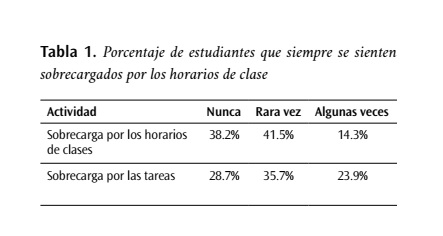
Figures
The term figure includes: photographs, graphics (not 3D), diagrams, drawings, maps, infographics, models. The explanation of the figure is made before, not after it has been placed. The figures must be in black and white. In addition, the number and the title are written in the lower part of the figure.
Example:
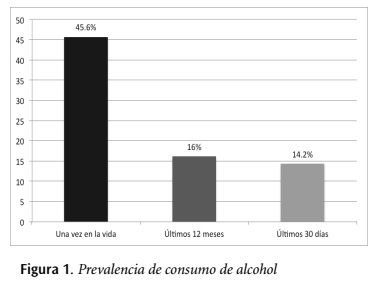
Prevalence of alcohol consumption
For once in a lifetime, consumption was 45.6% very similar. Tobacco consumption, for the last 12 months was 16.0% and for the last 30 days it was 14.2% (Figure 1).
Todos los envíos deben cumplir los siguientes requisitos.
© Crea Ciencia
Declaration of originality and assignment of rights
The article must be sent with a declaration of originality, responsibility and assignment of rights of copy of the manuscript, scanned and signed by the author or by one of the authors when the authorship is collective (designated author), stating that the text has not previously published in printed or electronic format, which will not be presented to any other media before knowing the decision of the journal Crea Ciencia and that, if accepted for publication, the authors transfer the copyrights in all forms and media known. At the end of six months of the publication, the text can be shared in another magazine citing the first version of the article published in Crea Ciencia and recording its number and volume. If the article is not published, the UEES agrees to return the rights enunciated to their authors.

Central American Journals Online (CAMJOL) is a member of the Ubiquity Partner Network coordinated by Ubiquity Press. According to the EU definitions, CAMJOL is the data controller, and Ubiquity Press are the service providers and data processors. Ubiquity Press provide the technical platform and some publishing services to CAMJOL and operate under the principle of data minimisation where only the minimal amount of personal data that is required to carry out a task is obtained.
More information on the type of data that is required can be found in Ubiquity Press’ privacy policy below.
We take seriously our duty to process your personal data in a fair and transparent way. We collect and manage user data according to the following Privacy Policy. This document is part of our Terms of Service, and by using the press portal, affiliated journals, book, conference and repository websites (the “Websites”), you agree to the terms of this Privacy Policy and the Terms of Service. Please read the Terms of Service in their entirety, and refer to those for definitions and contacts.
There are four main categories of personal data stored by our journal platform, our press platform, and our book management system; Website User data, Author data, Reviewer data and Editor data.
The minimum personal data that are stored are:
Optionally, the user can provide:
The data subjects have complete control of this data through their profile, and can request for it to be removed by contacting info@ubiquitypress.com
We regularly backup our databases, and we use reliable cloud service providers (Amazon, Google Cloud, Linode) to ensure they are kept securely. Backups are regularly rotated and the old data is permanently deleted. We have a clear internal data handling policy, restricting access to the data and backups to key employees only. In case of a data breach, we will report the breach to the affected users, and to the press/journal contacts within 72 hours.
Personal information is only used to deliver the services provided by the publisher. Personal data is not shared externally except for author names, affiliations, emails, and links to ORCiD and social media accounts (if provided) in published articles and books which are displayed as part of the article/book and shared externally to indexes and databases. If a journal operates under open peer review then the reviewer details are published alongside the reviewer details.
1.1 what data we collect
1.2 why we collect the data
1.3 what we do (and don’t do) with the data
1.4 what to do if you want to get a copy of your data, or want your data to be removed
2.1 what data we collect
2.2 why we collect the data
2.3 what we do (and don’t do) with the data
2.4 why we store the data
2.5 what to do if you want to get a copy of your data, or want your data to be removed
3.1 what data we collect
3.2 why we collect the data
3.3 what we do (and don’t do) with the data
3.4 what to do if you want to get a copy of your data, or want your data to be removed
4.1 what data we collect
4.2 why we collect the data
4.3 what we do (and don’t do) with the data
4.5 what to do if you want to get a copy of your data, or want your data to be removed
5.1 what data we collect
5.2 why we collect and store the data, and for how long
5.3 what we do (and don’t do) with the data
5.4 what to do if you want to get a copy of your data or want your data to be removed
We may choose to buy or sell assets. In the case that control of data changes to or from Ubiquity Press and a third party, or in the case of change of ownership of Ubiquity Press or of part of the business where the control of personal data is transferred, we will do our best to inform all affected users and present the options.
(Updated: 10 September 2025)
Established in 2011 and hosted by Ubiquity.
Managed by Mongolian Academy of Sciences.
This website supports the online publication of Mongolian journals. For more information about MongoliaJOL and how to join the service see the About page.
