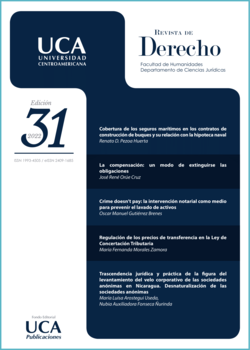
Regulation of transfer pricing in the tax concertation law
Keywords:
Tax authority, Related parties, Transfer pricing, Full competency principleAbstract
In the current international context and the globalized economy of multinationals, companies have extended their investments by settling in different jurisdictions through subsidiaries, companies of the same business group, or other corporate forms, to expand their commercial relations. Under this internationalization scenario, transfer pricing has acquired a transcendental incidence within the operations and transactions carried out between companies when dealing with their associated or related parties, making necessary its regulation in the different legal systems of the world. This research article addresses the regulatory framework of transfer pricing in Nicaragua since its entry into force in 2017.
797
Downloads
Published
How to Cite
Issue
Section
License
Copyright (c) 2021 Universidad Centroamericana (UCA)

This work is licensed under a Creative Commons Attribution-NonCommercial-ShareAlike 4.0 International License.
© Copyright Universidad Centroamericana (UCA)
The author undertakes not to submit any article to any other journal or publication simultaneously.The content of the research article is the sole responsibility of the author, as a result, the Law Journal is released from any responsibility derived from the content of the work.
The author assigns the Revista de Derecho, the right to publish the article, distribute it and market it in the way he considers convenient, nationally and internationally, in printed and electronic format;as well as its inclusion in directories, bibliographic bases and international indexes.

This work is licensed under a licencia de Creative Commons Reconocimiento-NoComercial-CompartirIgual 4.0.

