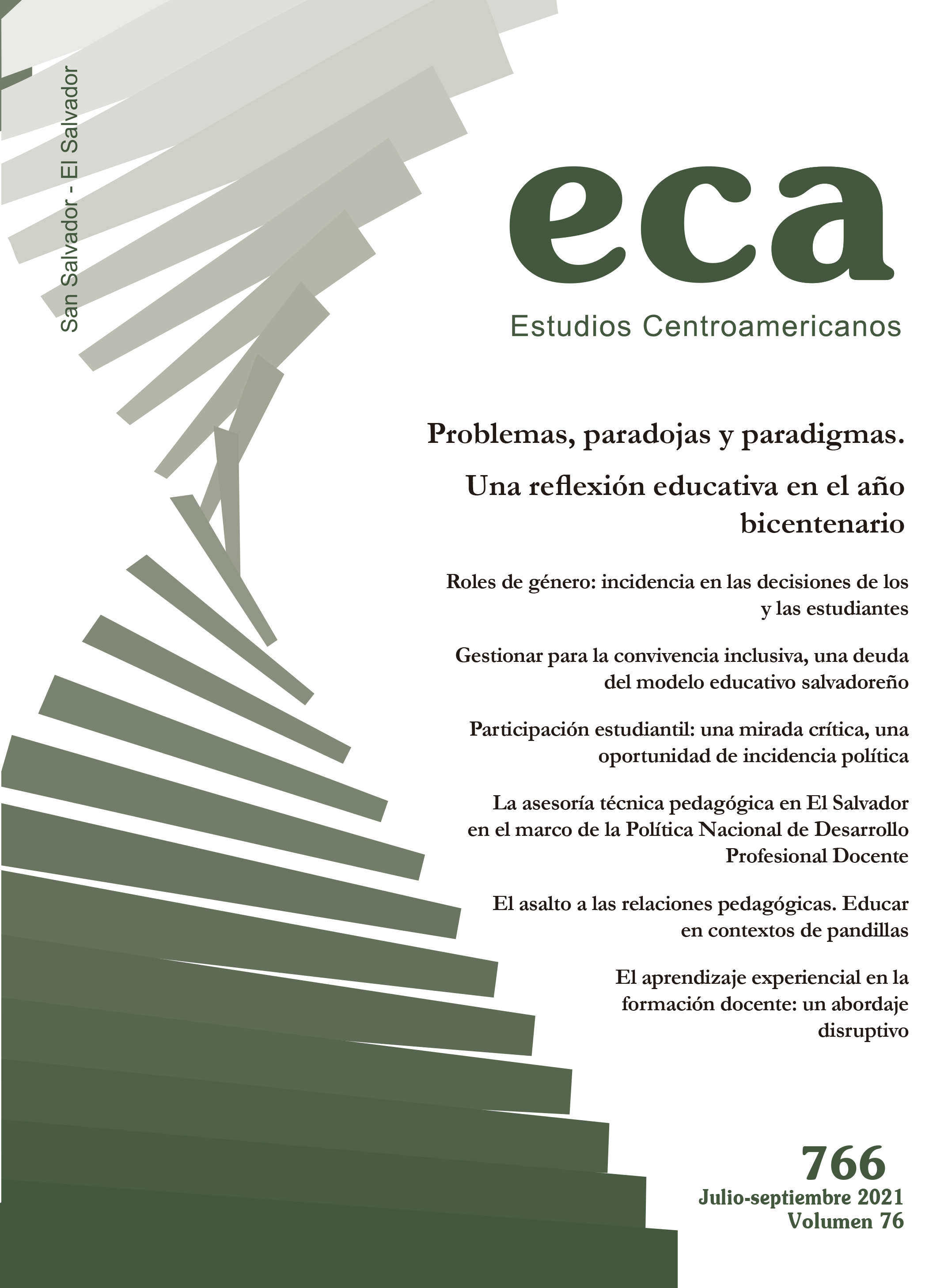
The experiential learning in teacher training: a disruptive approach
DOI:
https://doi.org/10.51378/eca.v76i766.6484Keywords:
Experimental learning, Teacher training, COVID-19, English Language Teaching, Disruptive approachesAbstract
This article proposes experiential learning as a methodology that can make a substantial contribution to the training of English language teachers in El Salvador, a country characterized by authoritarianism, confrontation, and a lack of critical and creative thinking. It then explains some of the fundamental principles of this approach, as well as the various challenges it poses to the prevailing paradigm of English language instruction in the country. It then highlights the contributions this approach offers to the training of professionals in the discipline through four experiences conducted between 2019 and 2020 with students and teachers at various levels of the Teacher Education Program and the Bachelor’s Degree in English Language at the José Simeón Cañas Central American University in El Salvador.
5
References
Ambrose, S., Bridges, M., DiPietro, M., Lovett, M. & Norman, M. (2010). How learning works: 7 research-based principles for smart teaching. Jossey-Bass.
Badillo Torres, D. A. (2021). Adaptación y validación de un instrumento para medir flexibilidad cognitiva de estudiantes de 4.° a 6.° año básico [Tesis de Magíster]. Pontificia Universidad Católica de Chile. https://repositorio.uc.cl/handle/11534/51220
Bartle, E. (2015). Experiential learning: an overview. Institute for Teaching and Learning Innovation. The University of Queensland.
Consorcio de Habilidades Indispensables para el Siglo XXI (2009). Logros indispensables para los estudiantes del siglo XXI [Web].
Eduteka. https://eduteka.icesi.edu.co/articulos/SeisElementos
Cooper, L., Orrell, J. & Bowden, M. (2010). Work Integrated Learning: A guide to effective practice. Routledge.
Fry, H., Ketteridge, S. & Marshall, S. (2009). A handbook for teaching and learning in higher education: Enhancing academic practice (3rd. Ed.). Routledge.
Griffiths, C. & Soruç, A. (2020). Language learning strategies. En Individual Differences in Language Learning (pp. 113-129). Palgrave Macmillan.
Harmer, J. (2001). The Practice of English Language Teaching (4th. Ed.). Pearson Longman.
Haynes, C. (2007). Experiential learning: Learning by doing. http://adulteducation.wikibook.us/index.php?title=Experiential_Learning_-_Learning_by_Doing
Kolb, D. (1984). Experiential learning: experience as the source of learning and development. Prentice Hall.
Kolb, D. (1976). The Learning Style Inventory. McBer and Company.
Kolb, D. & Fry, R. (1975). Toward an applied theory of experiential learning. En C. Cooper (Ed.), Theories of Group Processes (pp. 33-57). John Wiley.
Kolb, A. & Kolb, D. (2009). The Learning Way: Meta-cognitive Aspects of Experiential Learning. Simulation Gaming, 40(3), 297-327. https://journals.sagepub.com/doi/10.1177/1046878108325713
Ministerio de Educación [MINED]. (2020). Desarrollo socioemocional: Orientaciones para la familia. https://www.mined.gob.sv/materiales/f3/semana8/socioemocional/Orientaciones_familia_Sociomocional_I_ciclo_f3.pdf
Pilbeam, R., Conley, Q., Christopherson, R. & Bar rus, A. (2012). BrainBook: Instructional Design Leveraging Social Networking Features Increases Motivation and Engagement. En T. Amiel & B. Wilson (Eds.), Proceedings of EdMedia 2012 - World
Conference on Educational Media and Technology (pp. 1159-1166). Association for the Advancement of Computing in Education.
Riener, C. & Willingham, D. (2010). The myth of learning styles. Change: The Magazine of Higher Learning, 42(5), 32-35. https://www.researchgate.net/publication/249039450_The_Myth_of_Learning_Styles
Simpson, D. J., Jackson, M. J. & Simpson, J. C. (2004). John Dewey and the art of teaching: Toward reflective and imaginative practice. Sage Publications.
Organización de las Naciones Unidas para la Educación, la Ciencia y la Cultura y Oficina Regional de Educación para América Latina y el Caribe [UNESCO y OREALC]. (2017). Reporte E2030: Educación y habilidades para el siglo XXI. Reunión Regional de Ministros de Educación de América Latina y el Caribe, Buenos Aires, Argentina, 24 y 25 de enero de 2017. https://bibliotecadigital.mineduc.cl/bitstream/handle/20.500.12365/17284/E2030%20EducacionyhabilidadesSigloXXI.pdf?sequence=1&isAllowed=y
Wright, J. (2015). Experiential learning: An overview. Institute for Teaching and Learning Innovation. https://itali.uq.edu.au/files/1264/Discussion-paper-Experiential_learning_an_overview.pdf
Downloads
Published
How to Cite
Issue
Section
License

This work is licensed under a Creative Commons Attribution-NonCommercial-NoDerivatives 4.0 International License.
© ECA. Estudios Centroamericanos está bajo una licencia Creative Commons NonCommercial-NoDerivatives 4.0 International (CC BY-NC-ND 4.0).

La licencia no comercial y sin obra derivada permite la reproducción, distribución y comunicación pública, pero no la posibilidad de comercializar su contenido ni tampoco generar una obra derivada, como una traducción o adaptación, excepto que se pida permiso a los editores de dicha obra.
En ese sentido, se está en la libertad de:
Compartir: copiar y redistribuir el material en cualquier medio o formato.
Bajo las siguientes condiciones:
- Reconocimiento: se debe dar crédito a esta obra de manera adecuada, proporcionando un enlace a la licencia, e indicando si se han realizado cambios.
- Uso no comercial: no se puede hacer uso del material con fines comerciales.
- Sin obra derivada: si se remezcla, transforma o construye sobre ese material, no se puede distribuir el material modificado.

