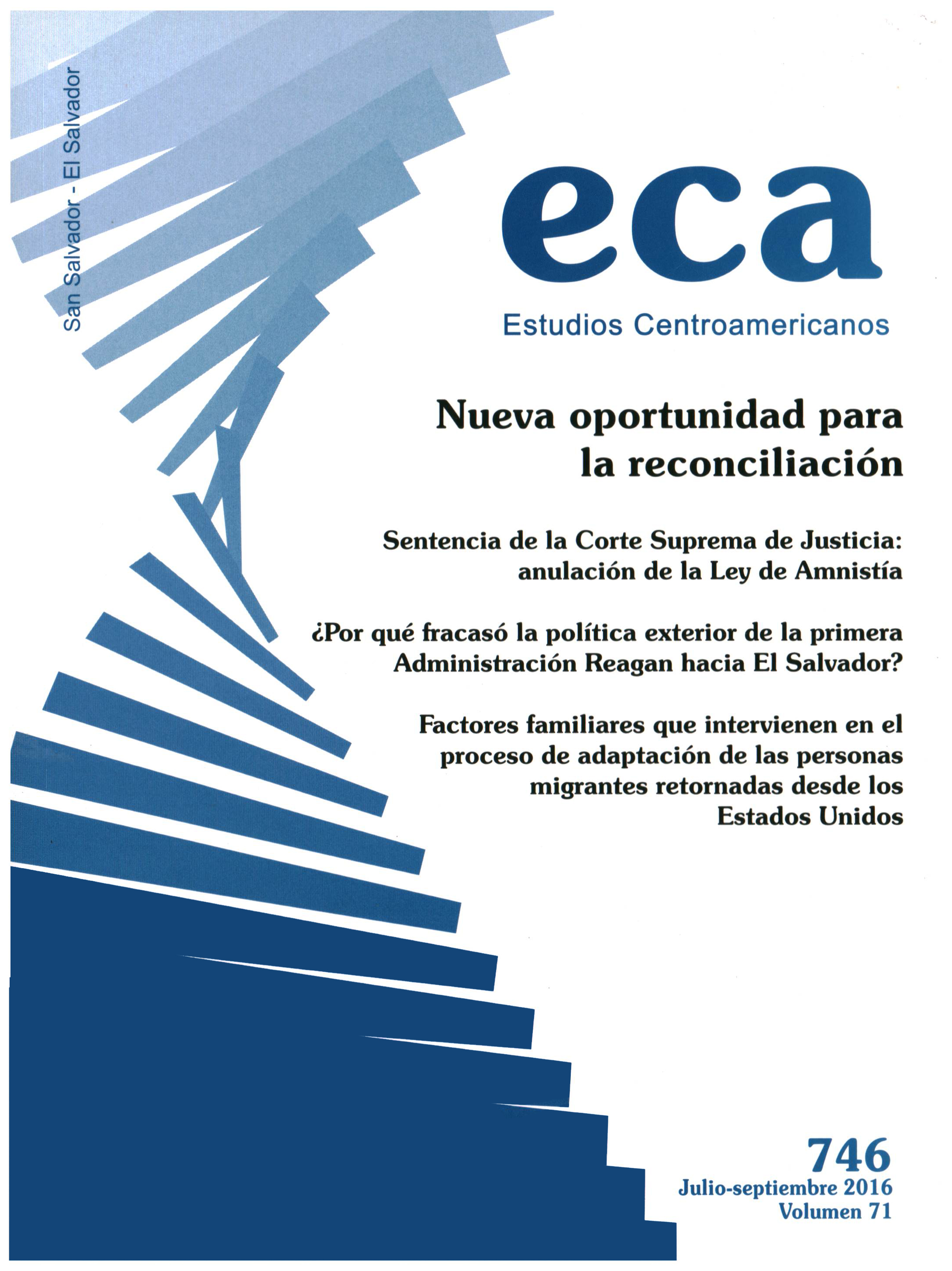
Why did the Reagan administration's foreign policy toward El Salvador fail during its first term?
DOI:
https://doi.org/10.51378/eca.v71i746.3189Keywords:
International laws, National security, Human rights, Geopolitics, Strategic interestsAbstract
Ronald Reagan, former president of the United States, implemented a militaristic foreign policy in an attempt to resolve a chronic problem in El Salvador that was not of a military nature. This paper will demonstrate that, from his perspective, any negotiated solution was tantamount to defeat for the United States. The only acceptable solution for Reagan was the military defeat of the insurgents and the overthrow of the Sandinistas in Nicaragua. According to Reagan, the causes of the Central American conflicts were not domestic but rather exported by international communism. This, in his view, threatened his country’s national security, which had to take precedence over any international law and at any cost.
1
References
Amnesty International (1973). Amnesty lnternational Report on Torture, 1973. London
---(1984). Amnesty lntemational Report, 1984. London.
---(1985). Amnesty lntemational Report, 1985. London.
Americas Watch Report (1990). El Salvador: en los casos de derechos humanos prevalece la impunidad.
Asamblea General de la Organización de las Naciones Unidas. Resoluciones. Accesible en: http://research.un.org/es/docs/ga/quick/regular/70
Benz, o. (1982). Americas in Transition. USA. Document desclasificado en octubre de 1982.
Boardman, W. (2013). "The CIA"s Mystery Man in Baghdad: Salvador-Style Death Squads in Iraq". Global Research, 2013. Accesible en: http://www.globalresearch.ca/the-cias-mystery-man-in-bagdad-salvadorstyle-death-squads-in-iraq/5330445
CIA (1980). Ochoa y asesinato de Romero. Documento desclasificado y fechado el 9 de octubre de 1980. Accesible en: http://unfinishedsentences.or?es/cia-ochoa-documentsl
Comandante Chepe (2014). Entrevista realizada en el extranjero (02/07/2014) a un excombatiente del FMLN en el Bajo Lempa, jurisdicción de Usulután. Él pidió ser identificado solo como "comandante Chepe".
Consejo de Seguridad de la Organización de las Naciones Unidas. Resoluciones. Accesible en: http://www.un.org/es/sc/documents/resolutions/
Constable, P (2015). "Robert E. White, who criticized policy on El Salvador as U.S. ambassador dies at 88". The Washington Post, 15 de enero de 2015.
Crandall, R. (2016). The Salvador Option: the United States in El Salvador, 1977-1992. Cambridge: Cambridge University Press.
Crawford, S. (2003). Century Small Arms: the World"s Great Infantry Weapons. England: Zenith Press.
Darman, P (2004). Sma/l Arms of the World. London: Grange Books Ltd.
Devetak, R.: Burke, A. & George, J. (eds.) (2007). An Introduction to International Relations: Australian Perspectives. Cambridge: Cambridge University Press.
Real Academia Española (1992). Diccionario manual e ilustrado de la lengua española. Calabria: B1BLOGRAF S/A.
La Prensa Gráfica (1992). El conflicto en El Salvador. San Salvador: Dutriz Hermanos, SA de C.V.
El Diario de Hoy (2004). "En una época en que la vida no valía nada". 13 de mayo 2004. Accesible en: http://archivo.elsalvador.com/noticias/2004/05/13/naciónal/nac18.asp
Evans, G. & Newnham, J. (1998). Dictionary of International Relations. England: Penguin Books.
Galeano, E. (1987). Memoria del fuego IlI. El siglo del viento. Argentina: Catálogos.
Golway, T. (2008). Ronald Reagan's America: his Voice, his Dream and his Vision of Tomorrow. Illinois: Sourcebooks Media Fusion.
Harvey, D. (2003). The New Imperialism. Oxford: Oxford University Press.
The Guardian & BBC Group (2013). James Steele: America's Mystery Man in Iraq. Documental. 7 de marzo de 2013. Narrado por Dearbhala Molloy.
Johnson, K. D. (1998). Ethics and Counterrevolution: American Involvement in Internal Wars. New York: University Press of America.
Kegley, C. W. Jr. & Wittkopf, E. R. (1999). World Politics: Trend and Transformation. New York: Worth Publishers.
Kenworthy, E. (1983). "Why The United States is in Central America". Bulletin of the Atomic Scientists, n.° 8, vol. 39, 1983, pp.14-18.
LaFeber, W. (1983). ''An Overview of Central America". Bulletin of the Atomic Scientists, n.? 8, vol. 39, 1983, pp. 11-13.
LeoGrande, W. M. (1998). Our Own Backyard: The United States in Central America, 1977-1992. Chapel Hill: The University of North Carolina Press.
LeoGrande, W. M. (1987). Central America and the Po/ls: a study of U.S. public opinion polls on U.S. foreign policy toward El Salvador and Nicaragua under the Reagan Administration. Washignton: WOLA.
Lopez Vigil, J. 1. (1992). Las mil y una historias de Radio Venceremos. San Salvador: UCA Editores.
Luis (2014). Entrevista realizada en el extranjero a un excombatiente del FMLN (02/07/2014). Su pseudónimo de guerra no era "Luis", pero pidió ser identificado con este nombre.
Lynch, E. A. (2011). The Cold War's Last Battlefield: Reagan, the Soviets, and Central America. A1bany: State University of New York Press.
Mauro y Alicia (2015). Entrevista realizada en el extranjero a una pareja de excombatientes del FMLN (03/10/2015). Sus pseudónimos de guerra, fueron "Mauro" y "Alicia", y así pidieron ser identificados.
Mayall, J. (1986). The United States in Foreign Policy and Human Rights, edited by Vincent, R. J. Cambridge: Cambridge University Press.
McGehee, R. (1981). "The CIAand The White Paper On El Salvador", The Nation, 11 de abril de 1981. Accesible en: http://www.thenation.com/sites/default/files/guide201304-01.pdf
National Security Decision Directive 124 (1984). "Central America: Promoting Democracy, Economic Improvement and Peace". The White House, Washington, 7 de febrero de 1984. Accesible en: http://www.reagan.utexas.edu/archives/reference/Scanned%20NSDDS/NSDD11O.p
National Security Decision Directive 110 (1983). "Granada: Contingency Planning". The White House, Washington, 21 de octubre de 1983. Accesible en: http://www.reagan.utexas.edu/archives/reference/Scanned%20NSDDS/NSDD100.p
National Security Decision Directive 100 (1983). "Enhanced U.S. Military Activity and Assistance for the Central American Region". The White House, Washington, 28 de Julio de 1983. Accesible en: http://www.reagan.utexas.edu/archives/reference/Scanned%20NSDDS/NSDD71.p
National Security Decision Directive 71 (1982). "U.S. Policy Toward Latin America in the Wake of the Falklands Crisis". The White
House, Washington, 30 de noviembre de 1982. Accesible en: http://www.reagan.utexas.edu/archives/reference/Scanned%20NSDDS/NSDD59.p
National Security Decision Directive 59 (1982). "Cuba and Central America". The White House, Washington, 29 de junio de 1982. Accesible en: http://www.reagan.utexas.edu/archives/reference/Scanned%20NSDDS/NSDD17.p
National Security Decision Direetive 21 (1982). "Responding to Floggers in Cuba". The White House, Washington, 5 de octubre de 1982. Accesible en: http://www.reagan.utexas.edu/archives/reference/Scanned%20NSDDS/NSDD37A.p
National Security Decision Directive 124 (1984). "Central America: Promoting Democracy, Economic Improvement, and Peace". The White House, Washington, 7 de febrero de 1984. Accesible en: http://fas.org.irp/offdocs/nsdd-124.pdf
National Security Decision Directive 264 (1987). "Central America". The White House, Washington, 27 de febrero de 1987. Accesible en: http://fas.org.irp/offdocs/nsdd264.pdf
National Security Decision Directive 59 (1982). "Cuba and Central America". The White House, Washington, 5 de octubre de 1982.
Accesible en: http://fas.org.irp/offdocs/nsdd059.pdf
National Security Decision Directive 225 (1986). "Central America: U.S. Policy on the Search for a Negotiated Solution". The White House, Washington, 20 de mayo de 1986. Accesible en: http://fas.org.irp/offdocs/nsdd-225.pdf
National Security Decision Directive 37 (1982). "National Security Decision Directive on Cuba and Central America". The White House, Washington, 28 de mayo de1982. Accesible en: http://fas.org.irp/offdocs/nsdd037.pdf
Negroponte, D. V. (2012). Seeking Peace in El Saluador: The Struggle to Reconstruct a Nation at the End o/ the Cold War. New York: Palgrave McMillan.
Nieto, C. (2003). Masters o/ War: Latin America and U.S Aggression - From the Cuban Revolution Through the Clinton"s Years. New York: Seven Stories Press.
Petras, J. (1981). "White Paper on the White Paper", Third World Traveler, 28 de marzo de 1981. Accesible en: http://www.thridworldtraveler.com/lndependent_Media/White_Paper_SNM.htrnl
The New York Times. "Salvador Rebels Bid Reagan Accept a Negotiated Solution". 28 de enero de 1982. Accesible en: http://www.nytimes.com/1982/0l/28/world/salvador-s-rebels-bid-reagan-accept-a-nego.
Severo, R. (1992). "Roberto D'Aubuisson, 48, Far-Rightist in Salvador". The New York Times, 21 de febrero de 1992.
Smith, C. (1996). Resisting Reagan: The U.S. - Central America Peace Mouement. Chicago: The University of Chicago Press.
Sprenkels, R. (2014). "Las relaciones urbanorurales en la insurgencia salvadoreña", en Historia y debates sobre el conflicto armado saluadoreño y sus secuelas. San Salvador: Universidad de El Salvador/Fundación Friedrich Ebert.
Tickner, A. B. (2012). Rising Brazil and South America in Foreign Policy: Theories/Actors/ Cases, edited by Smith, S., Hadfield, A. & Dunne, T. Oxford: Oxford University Press.
Tyler, H. R. Jr. (1983). "The Church Women Murder: A Report To The Secretary Of State", New York, diciembre de 1983. Accesible en: http://foia.state.gov/searchapp/DOCUMENTS/churchwomen/3925.pdf
United States Departrnent of Justice, Executive Office For Immigration Review, Immigration Court, Miami, Florida, In the Matter of GARCIA-MERINO, José Guil1ermo (Respondent [Acusado]), 28th day of February 2014.
Downloads
Published
How to Cite
Issue
Section
License

This work is licensed under a Creative Commons Attribution-NonCommercial-NoDerivatives 4.0 International License.
© ECA. Estudios Centroamericanos está bajo una licencia Creative Commons NonCommercial-NoDerivatives 4.0 International (CC BY-NC-ND 4.0).

La licencia no comercial y sin obra derivada permite la reproducción, distribución y comunicación pública, pero no la posibilidad de comercializar su contenido ni tampoco generar una obra derivada, como una traducción o adaptación, excepto que se pida permiso a los editores de dicha obra.
En ese sentido, se está en la libertad de:
Compartir: copiar y redistribuir el material en cualquier medio o formato.
Bajo las siguientes condiciones:
- Reconocimiento: se debe dar crédito a esta obra de manera adecuada, proporcionando un enlace a la licencia, e indicando si se han realizado cambios.
- Uso no comercial: no se puede hacer uso del material con fines comerciales.
- Sin obra derivada: si se remezcla, transforma o construye sobre ese material, no se puede distribuir el material modificado.

