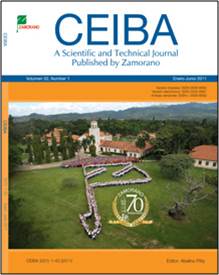
Zamorano Environmental roll: Environment and Biodiversity Protection
DOI:
https://doi.org/10.5377/ceiba.v52i1.1035Keywords:
Biodiversity, clean production, energy, forestry, herbarium, insects, water, watersheds.Abstract
Zamorano is a university dedicated to forming professionals in the agricultural sciences. Many social and environmental responsibilities are integral parts of this formation. An example of this responsibility is that the university offers formal training in environmental engineering and development thru the Department of Environment and Development. During its 70 years of existence, Zamorano has continually increased its activities in favor of the environment. By 1948 Zamorano´s first director, Dr. Wilson Popenoe, proposed the creation of a biological reserve for protection of the Uyuca cloud forest. These management activities have culminated nowadays with the highest efficiency of any protected area in Honduras. The Uyuca Biological Reserve provides ecosystem services of great value, especially potable water for our community. Zamorano manages nearly 3000 ha of forest in which students take part by means of the learning by doing training program. The tasks include aspects of forestry, including fire prevention and control measures by clearing brush and controlled burns, and the control of insect pests. Zamorano possesses several forest species collections on the campus, useful for education and research purposes. The Paul C. Stanley herbarium contains more than 300,000 specimens. The Zamorano insect collection has more than 200,000 identified specimens, including 324 type specimens and 14 species endemic to Honduras. A donation of 250,000 insect specimens organized by Dr. Jean Michel Maes from Nicaragua is being integrated to the collection, and will be one of the largest in Central America. The herbarium and the insect collections were the basis for creating the Zamorano Biodiversity Center dedicated to the promotion of generating new knowledge and conservation of the biodiversity. Other centers of academic excellence operate in Zamorano for environmental improvement. These include the Center of Certification of Improved Stoves and the Zamorano Center for Renewable Energy. At the same time Zamorano is developing Eco-Zamorano and Green Zamorano programs as strategies for better environmental protection and improved efficiency in energy utilization.
DOI: http://dx.doi.org/10.5377/ceiba.v52i1.1035
Downloads
1805