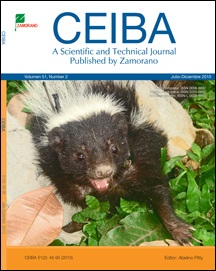
Home Range and Movements of the Hooded Skunk (Mephitis macroura) in the Rainy Season on the Zamorano Campus, Honduras
DOI:
https://doi.org/10.5377/ceiba.v51i2.953Keywords:
Carnivores, radiolocalizations, radiotelemetryAbstract
The hooded skunk (Mephitis macroura) occurs in the southwest United States, Mexico and Central America but information available for the species in the latter region is limited. Several general aspects of the ecology of this skunk were identified in the campus of Zamorano University (Escuela Agrícola Panamericana), Honduras. Although eight individuals were tracked by telemetry for variable periods of time only the home range of two males, a young male and an adult female were determined for a period of four months. Home range size of these individuals varied between 3.4 and 32.4 ha (mean = 16.8 ha). Home range size of the three males was larger than the female´s and the home range size of the two adult males was larger than that of the young male. Intersection did not exist between the areas of both adult males but the home range of the female was inside the male home ranges. Skunk localizations were in green areas (gardens with trees), buildings, shrubs, rock walls, rubble, underground burrows, and trash-bins. Rock walls and student buildings are skunk refuges since they provide spaces adequate for resting, protection, feeding, and reproduction. The tracked female had four babies which were observed at the end of the study (September, 2009).
Downloads
2931