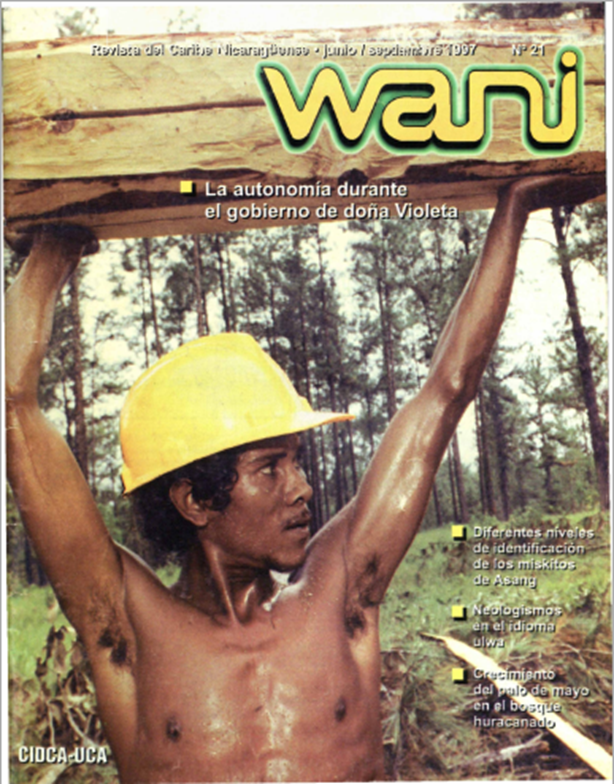
Diferentes niveles de identificación de la población miskita de Asang, río Coco
Palabras clave:
Asang, Distribución de la población, Historia, Identidad culturalResumen
El tema de este artículo son los diferentes niveles de autoidentificación de los miskitos de Asang. Esta es una comunidad localizada en la parte de arriba del río Coco, la. cual fue estudiada por la antropóloga norteamericana Mary Helms a final de los sesentas. La autora de este articulo hizo trabajo de campo. en varias ocasiones en Asang, entre 1993 y 1994. El principal argumento es que la identidad social resulta de la forma en que los individuos se visualizan a sí mismos y cómo son visualizados por otros. Esto induce a la discusión de que los individuos definen su identidad social de distintas maneras en diferentes periodos históricos.
424
Referencias
Alegret, J. L. (1975). «La comarca de Cabo Gracias a Dios: apuntes para su historia». Encuentro, 24-25: 65–94.
Borhek, M. (1949). Watchmen on the Walls. Moravian Missions in Nicaragua During the Last Fifty Years. Bethlehem: The Society for Propagating the Gospel.
CIERA. (1981). La Mosquitia en la revolución. Managua: CIERA.
Conzemius, E. (1932). Ethnographical Survey of the Miskito and Sumu Indians of Honduras and Nicaragua. Smithsonian Institution. Washington: Bureau of American Ethnology, Bulletin 106.
García, Claudia. (1996). The Making of the Miskitu People of Nicaragua: The Social Construction of Ethnic Identity. Acta Universitatis Upsaliensis, 41.
Haglund, D. (1948). Rött Kontra Vitt: Bland indianer och rövare. Stockholm: Viktor Petterson Bokindustri.
Helms, M. (1971). Asang: Adaptaciones al contacto cultural en una sociedad misquita. Instituto Indigenista Interamericano.
Kerns, V. (1983). Women and the Ancestors. Urbana: University of Chicago Press.
Murray, C. (1981). Families Divided: The Impact of Migrant Labour in Lesotho. Cambridge: Cambridge University Press.
MW. (1699). The Mosquito Indians and His Golden River. In A Collection of Voyages and Travels, Vol. 6. London: A. Churchill.
Stack, Carol. (1974). All Our Kin: Strategies for Survival in a Black Community. New York: Harper & Row.
Tanner, N. (1974). «Matrifocality in Indonesia and Africa and among Black Americans». In M. Rosaldo & L. Lamphere (Eds.), Women, Culture and Society. Stanford: Stanford University Press.
Iglesia Católica de Waspam. (1985). [sin título]. Waspam, Río Coco - RAAN.
Descargas
Publicado
Número
Sección
Licencia
Derechos de autor 2024 Bluefields Indian and Caribbean University

Esta obra está bajo una licencia internacional Creative Commons Atribución-NoComercial-CompartirIgual 4.0.


