
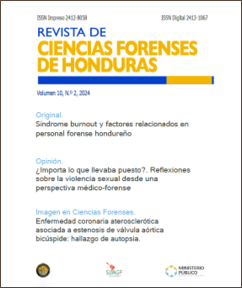
Burnout syndrome and related factors in Honduran forensic personnel
DOI:
https://doi.org/10.5377/rcfh.v10i2.20373Keywords:
Burnout, Forensic Medicine, Forensic personal, Burnout Psychological, Occupational stress, Mental HealthAbstract
Justification: Although burnout and occupational stress are significant issues among forensic professionals due to the nature of their work, only a few studies have addressed burnout among this group.
Objective: To analyze the prevalence of burnout among employees of the Honduran Directorate of Forensic Medicine and identify associated factors to support the future design of preventive measures.
Methodology: A cross-sectional analytical study conducted using a voluntary and anonymous online survey, with a non-probabilistic convenience sample of staff who agreed to participate. The survey was distributed electronically to all departments of the Honduran Directorate of Forensic Medicine nationwide, using the Maslach Burnout Inventory – Human Services Survey (MBI-HSS) in its three dimensions, adapted and validated in Spanish. For categorical demographic variables, the likelihood ratio test was applied within a univariable logistic regression model. Variables with a p-value less than 0.05, along with those previously reported as relevant, were considered candidates for multivariable analysis, which was conducted using multinomial logistic regression models for the variables of interest. Point prevalence was calculated as the ratio of identified cases to the total study population.
Results: Among the 204 participating employees, between 18% and 34% fell into the "high" burnout range for at least one of its dimensions, and at least 18% exhibited high levels in all three burnout dimensions. Both age and work-related stressors linked to institutional factors were significantly associated with burnout prevalence.
Conclusion: Our findings highlight the need to prioritize certain specific organizational factors that could potentially be contributing to the observed burnout levels among forensic personnel, as well as the importance of further research on this topic, particularly within the Directorate of Forensic Medicine in Honduras and among forensic professionals in general.
Downloads
1351
HTML (Español (España)) 45
References
1. Saborío Morales L, Hidalgo Murillo LF. Síndrome de Burnout. Med Leg Costa Rica [Internet]. 2015 [citado 6 enero 2024];32(1):119-24. Disponible en: http://www.scielo.sa.cr/scielo.php?script=sci_arttext&pid=S1409-00152015000100014&lng=en.
2. Gutiérrez Aceves GA, Celis López MA, Moreno Jiménez S, Farías Serrato F, Suarez Campos J. Síndrome de burnout. Arch Neurocien [Internet]. 2006 [citado 6 enero 2024];11(4):305-9. Disponible en: https://www.medigraphic.com/pdfs/arcneu/ane-2006/ane064m.pdf
3.Organización Mundial de la Salud. Clasificación Internacional de Enfermedades CIE 11, estadísticas de mortalidad y morbilidad: Trastornos mentales, del comportamiento y del neurodesarrollo. Ginebra: OMS; 2019.
4.World Health Organization. Burn-out an occupational phenomenon: international classification of diseases [Internet]. Geneva: WHO; 2019 [citado 6 enero 2024]. Disponible en: https://www.who.int/news/item/28-05-2019-burn-out-an-occupational-phenomenon-international-classification-of-diseases
5. Lovo J. Síndrome de burnout: un problema moderno. Rev entorno [Internet]. 2021 [Citado 6 enero 2024];(70):110-20. Disponible en: https://camjol.info/index.php/entorno/article/view/10371 doi: https://doi:.org/10.5377/entorno.v0i70.10371
6. Kaschka WP, Korczak D, Broich K. Burnout: a fashionable diagnosis. Dtsch Arztebl In 2011;108(46):781-7. doi: 10.3238/arztebl.2011.0781.
7. Bakusic J, Ghosh M, Polli A, Bekaert B, Schaufeli W, Claes S, et al. Epigenetic perspective on the role of brain-derived neurotrophic factor in burnout. Transl Psychiatry [Internet]. 2020 [citado 6 enero 2024];10(1):354. Disponible en: https://pmc.ncbi.nlm.nih.gov/articles/PMC7573604/#CR6 doi: 10.1038/s41398-020-01037-4.
8. Koutsimani P, Montgomery A, Georganta K. The relationship between burnout, depression, and anxiety: a systematic review and meta-analysis. Front Psychol [Internet]. 2019 [citado 6 enero 2024];10:284. Disponible en: https://pmc.ncbi.nlm.nih.gov/articles/PMC6424886/ doi: 10.3389/fpsyg.2019.00284.
9. Jeanguenat AM, Dror IE. Human factors effecting forensic decision making: workplace stress and well-being. J Forensic Sci [Internet]. 2018 [citado 6 enero 2024];63(1):258-61. Disponible en: https://pubmed.ncbi.nlm.nih.gov/28464220/ doi: 10.1111/1556-4029.13533.
10. Sablone S, Groicher M, Patrizia Fanco T, Risola R, Violante GM, Bellino M, et al. Estrés laboral en médicos legistas: La necesidad de apoyo psicológico sistemático. Una perspectiva italiana. Forensic Sci Res. 2023; 8(2):116–22. doi: 10.1093/fsr/owad018.
11. Cano-López I, Pérez MI, Puig-Pérez S. Burnout is related to executive dysfunction in primary healthcare professionals working in rural areas. Rev Neurol. 2023;76(3):91-9. doi: 10.33588/rn.7603.2022283.
12. Alva Vásquez SS. Relación entre factores organizacionales y síndrome de burnout en el personal técnico-administrativo de servicios médico legales: un análisis por áreas de desempeño. BIS [Internet]. 2024 [citado 13 marzo 2024];5(3):124-43. Disponible en: https://www.innovasciencesbusiness.org/index.php/ISB/article/view/190
13. Lombardo C, Capasso E, Li Rosi G, Salerno M, Chisari M, Esposito M, et al. Burnout and stress in forensic science jobs: a systematic review. Healthcare (Basel) [Internet]. 2024 [citado 6 enero 2024];12(20):2032. Disponible en: https://pmc.ncbi.nlm.nih.gov/articles/PMC11506976/ doi: 10.3390/healthcare12202032
14. Marichal Bustamante FR. Factores asociados al síndrome de burnout en médicos y enfermeras en los hospitales públicos, de la región metropolitana [Tesis en línea]. Tegucigalpa: UNAH; 2022. [citado 13 marzo 2024]. Disponible en: http://www.bvs.hn/TME/pdf/TME39/pdf/TME39.pdf
15. Contreras Ramírez NA. Síndrome de burnout en docentes de la carrera de enfermería [Tesis en línea]. Tegucigalpa: UNAH; 2014. [citado 13 marzo 2024]. Disponible en: http://www.bvs.hn/TMSP/pdf/TMSP27/pdf/TMSP27.pdf
16. Álvarez Trejo JD, Ardón Ledezma RA. Síndrome de burnout y plenitud existencial en los docentes de El Progreso, Yoro. PARADIGMA [Internet]. [citado 12 marzo 2024];27(44):51-74. Disponible en: https://www.camjol.info/index.php/PARADIGMA/article/view/10526
17. Maslach C, Jackson SE, Leiter MP, Schaufeli WB, Schwab RL. Maslach Burnout Inventory (MBI). Menlo Park CA: Mind Garden; 2024.
18. Gil-Monte PR. Factorial validity of the Maslach Burnout Inventory (MBI-HSS) among Spanish professionals. Revista de Saúde Pública. [Internet]2005[citado 13 marzo 2024]; 39:1–8. Disponible en: https://www.scielo.br/j/rsp/a/K4vX6njNZtFGcVcSfwbrsnR/?lang=en
19. Brady KJS, Ni P, Sheldrick RC, Trockel MT, Shanafelt TD, Rowe SG, et al. Describing the emotional exhaustion, depersonalization, and low personal accomplishment symptoms associated with Maslach Burnout Inventory subscale scores in US physicians: an item response theory analysis. J Patient Rep Outcomes [Internet]. 2020 [citado 6 enero 2024];4(1):42. Disponible en: https://pmc.ncbi.nlm.nih.gov/articles/PMC7266903/ doi: https://doi.org/10.1186/s41687-020-00204-x
20. Zuin DR, Peñalver F, Zuin MP. Síndrome de burnout o de agotamiento profesional en la neurología argentina. Resultados de una encuesta nacional. Neurol Arg [Internet]. 2020 [citado 6 enero 2024];12(1):4-12. Disponible en: https://www.elsevier.es/es-revista-neurologia-argentina-301-avance-resumen-sindrome-burnout-o-agotamiento-profesional-S1853002819300680 doi: 10.1016/j.neuarg.2019.09.005
21. Hamed RA, Abd Elaziz SY, Ahmed AS. Prevalence and predictors of burnout syndrome, post-traumatic stress disorder, depression, and anxiety in nursing staff in various departments. MECP. 27(36):1-8. doi: https://doi.org/10.1186/s43045-020-00044-x
22. Hosmer DW, Lemeshow S, Sturdivant RX. Applied logistic regression. New York: John Wiley; 2013. doi:10.1002/9781118548387
23. R Foundation. The R Project for Statistical Computing. [Internet]. Vienna: R Foundation; 2024. [citado 13 marzo 2024]. Disponible en: https://www.r-project.org/
24. Posit team. RStudio: Integrated Development Environment for R. Posit Software. [Internet]. Boston: Scientific Research Publishing Inc; 2024. [citado 13 marzo 2024]. Disponible en: https://www.scirp.org/reference/referencespapers?referenceid=3810421
25. López-Andreu ME, Llorca-Rubio JL, Llorca-Pellicer M, Gil-La Orden P. Síndrome de quemarse por el trabajo (burnout) y sus consecuencias entre personal forense. Relación con vergüenza y culpa. Liberabit [Internet]. 2023 [citado 6 enero 2024];29(1):e641. Disponible en: https://www.redalyc.org/journal/686/68675542006/html/ doi: https://doi:.org/10.24265/liberabit.2023.v29n1.641
26. Alva Vásquez SS. Relación entre factores organizacionales y síndrome de burnout en el personal técnico-administrativo de servicios médico legales: un análisis por áreas de desempeño. BIS [Internet]. 2024 [citado 6 enero 2024];5(3):124-43. Disponible en: https://www.innovasciencesbusiness.org/index.php/ISB/article/view/190/195 doi: https://doi:.org/10.5281/zenodo.13845071.
27. Khatab Z, Hanna K, Rofaeil A, Wang C, Maung R, Yousef GM. (2023). Carga de trabajo, agotamiento y bienestar del patólogo: conectando los puntos. Crit Rev Clin Lab Sci [Internet]. 2024 [citado 6 enero 2024];61(4):254-274. Disponible en: https://pubmed.ncbi.nlm.nih.gov/38809116/
28.-Marsollier RG. La despersonalización y su incidencia en los procesos de desgaste laboral. Rev Psicología.com. 2013;17(7):1-10.
29. Escamilla-Quintal M, Rodríguez-Molina I, Peiró JM, Marco IT. El cinismo: una estrategia de afrontamiento diferencial en función del género. Psicothema [Internet]. 2008 [citado 6 enero 2024];20(4):596-602. Disponible en: https://www.redalyc.org/pdf/727/72720414.pdf
30. Jeanneau M, Armelius K. Self-image and burnout in psychiatric staff. J Psychiatr Ment Health Nurs [Internet]. 2000 [citado 6 enero 2024];7(5):399-406. Disponible en: https://pubmed.ncbi.nlm.nih.gov/11933466/
31. Benevides-Pereira AMT, Porto-Martins PC, Basso Machado PG. Síndrome de burnout en psicólogos clínicos. [Internet]. 11º Congreso Virtual de Psiquiatría. Interpsiquis; 2010.[citado 6 enero 2024]. Disponible en: https://psiquiatria.com/trabajos/40cof1745619.pdf
32. Martínez Ramón JP. Cómo se defiende el profesorado de secundaria del estrés: burnout y estrategias de afrontamiento. Rev Psicol Trab Organ [Internet]. 2015 [citado 4 abril 2024];3(1): 1-9. Disponible en: https://scielo.isciii.es/scielo.php?script=sci_abstract&pid=S1576-59622015000100001
33. Mäkikangas A, Leiter MP, Kinnunen U, Feldt T. Profiling development of burnout over eight years: relation with job demands and resources. Eur J Work Organ Psychol [Internet]. 2021 [citado 6 enero 2024];30(5):720–31. Disponible en: https://doi:.org/10.1080/1359432X.2020.1790651 doi: 10.1080/1359432X.2020.1790651
34. Martínez Pérez A. El síndrome de burnout. Evolución conceptual y estado actual de la cuestión. Vivat Academia [Internet]. 2010 [citado 3 abril 2024];(112):42-80. Disponible en: https://www.vivatacademia.net/index.php/vivat/article/view/192/188
35. Alarcon GM. A meta-analysis of burnout with job demands, resources, and attitudes. J Vocat Behav. 79(2), 549–62. doi:10.1016/j.jvb.2011.03.007 10.1016/j.jvb.2011.03.007
36. Bakker AB, de Vries J. Job Demands–Resources theory and self-regulation: new explanations and remedies for job burnout. Anxiety Stress & Coping [Internet]. 2021 [citado 6 enero 2024];34(1):1-21. Disponible en: https://doi.org/10.1080/10615806.2020.1797695
37. Bayes A, Tavella G, Parker G. The biology of burnout: causes and consequences. World J Biol Psychiatry [Internet]. 2021 [Citado 6 enero 2024];22 (9):686–98. Diponible en: https://www.tandfonline.com/doi:/full/10.1080/15622975.2021.1907713?src=recsys doi: https://doi.org/10.1080/15622975.2021.1907713.
Published
How to Cite
Issue
Section
License
Copyright (c) 2024 Mireya Matamoros, Gladis Mariela Zúniga, Jorge Luis Pérez Maldonado

This work is licensed under a Creative Commons Attribution-NonCommercial 4.0 International License.
El autor conserva los derechos de autor bajo los terminos de una licencia CC NC 4.0



