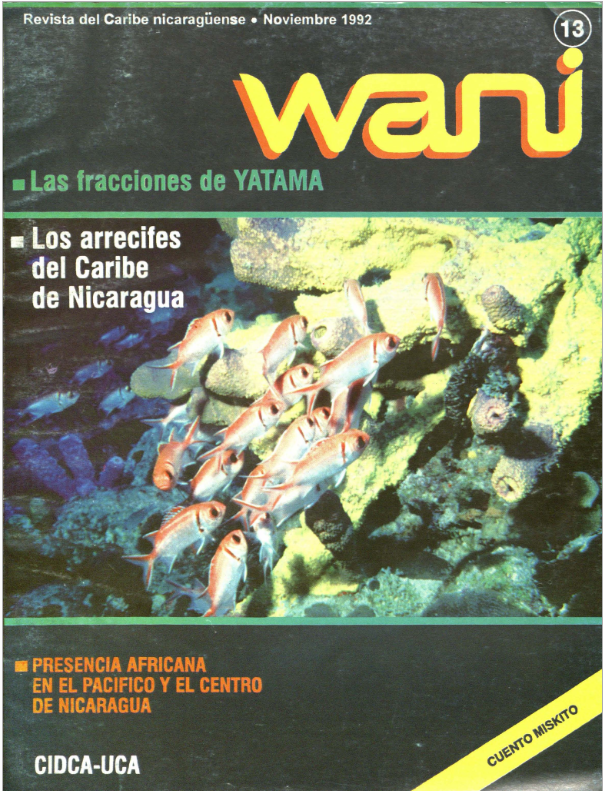
Nicaraguan Caribbean reefs
Keywords:
Coral reef, Effects of human activities, Marine ecosystem, Natural resourcesAbstract
In the preceding issue of Wani, I briefly discussed three of the planet's most productive ecosystems seagrasses, mangroves and corals that abound on the extensive continental shelf of the Nicaraguan Caribbean. This article, the second in a series, brings together the scarce information available on coral reef ecosystems in the South Atlantic Autonomous Region (RAAS), the offshore ecological counterpart of Nicaragua's tropical rainforests. For more than 230 million years, corals and the spectacular creatures that inhabit them have evolved together in the world's tropical oceans. The enormous diversity of plants and animals we see today in coral reefs (a single coral reef can support thousands of species of host flora and fauna) are the result of millions of years of biological change and adaptation by the powerful forces of nature. Survivors are adapted to live within the narrow range of tolerance set by the physical (e.g., tides, currents, water transparency) and chemical (salinity, nutrients) parameters that characterize the areas in which the reefs grow. Time has also produced intricate ecological and behavioral relationships found in few other places on the planet.
Downloads
374
References
Birkeland, C. (1990). "Caribbean and Pacific Coastal marine Systems: Similarities and differences". Nature and Resources 26 (2): 3-21.
Cortés J. and M. Risk (1985). "A reef under siltation stress: Cahuita, Costa Rica". Bulletin of Marine Science 36 (2): 339-356.
Crossland, C. J., B. G. Hatcher, and S. V. Smith (1991). "Role of coral reefs in global ocean production". Coral Reefs 10: 55-64.
Hatcher, B. G., R. E. Johannes, and A. I. Robertson (1989). "Review of Research Relevant to the Conservation of Shallow Tropical Marine Ecosystems". Oceanogr. Mar. Biol. Ann. Rev.: 337-414.
Hudson, J. H. (1981). "Growth rates in Montastrea annularis: A record of environmental change in Key Largo Coral Reef Sanctuary, Florida". Bulletin of Marine Science 31 (2): 444-459.
Kjerfve, B. J., K. E. Magill, J. W. Porter, and J. D. Woodley (1986). "Hindcasting of hurricane characteristics and observed storm damage of a fringing reef, Jamaica, West Indies." J. Mar. Res. 44: 119-148.
Liddell, W. D. and S. L. Ohlhorst (1986). "Changes in benthic community composition following the mass mortality of Diadema in Jamaica". J. Exp. Mar. Biol. Ecol. 95: 271-278.
Lighty, R. G., I. G. MacIntyre, and R. Stuckenrath (1982). "Acropora palmata reef framework: A reliable indicator of sea level rise in the Western Atlantic for the past 1,000 years". Coral Reefs 1: 125-130.
Longhurst, A. R. and D. Pauly (1987). Ecology of Tropical Oceans. Academic Press, 407 pp.
Murray, S. P. and M. Young (1985). "The nearshore current along a high-rainfall, trade-wind coast—Nicaragua". Estuarine, Coastal, and Shelf Science 21: 687-693.
Newell, N. D. (1971). "An outline of the history of tropical organic reefs". American Museum of Nat. History Novitates (2465): 1-37.
Roberts, H. H. and S. P. Murray (1983). "Controls on reef development and the terrigenous-carbonate interface on a shallow shelf, Nicaragua (Central America)". Coral Reefs 2: 71-80.
Roberts, H. H. and J. N. Suhayda (1983). "Wave-current interactions on a shallow reef (Nicaragua, Central America)". Coral Reefs 1: 209-214.
Rogers, C. S. (1979). "The effect of shading on coral reef function". J. Exp. Mar. Biol. Ecol. 41: 269-288.
Ryan, J. D., J. Rudloe and A. Rudloe (1989). Effects of Hurricane Joan on coral reefs, seagrass meadows and associated marine fauna near Corn Island, Nicaragua. Greenpeace Special Report.
Downloads
Published
How to Cite
Issue
Section
License
Copyright (c) 2024 Bluefields Indian and Caribbean University

This work is licensed under a Creative Commons Attribution-NonCommercial-ShareAlike 4.0 International License.


