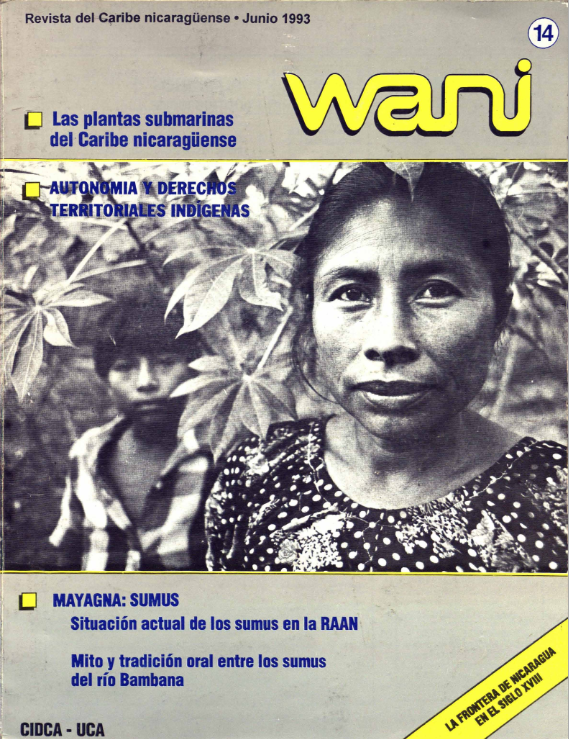
Underwater Plants of the Nicaraguan Caribbean
Keywords:
Aquatic plants, Coral reef, Human ecology, Land useAbstract
The following article attempts to provide a brief explanation of the physical, chemical and ecological role of seagrasses and algae in the Nicaraguan Caribbean environments. The marine plants of the Caribbean coast of Nicaragua cover the enormous Nicaraguan continental shelf. It is no coincidence that the enormous marine savannas of algae and seagrasses thrive on the otherwise featureless flat shelf. The clear blue water and shallow depth (average depth is only 30 meters), create ideal conditions for underwater photosynthesis that is driven by the intense tropical sunlight that drives all plant life on land. Marine plant communities can be found throughout the Nicaraguan shelf, from the Miskito, Pearl, Kings, and Man O' War Cays to the Corn Islands. Although few scientific studies have been conducted on the flora of the Nicaraguan Caribbean, at least 106 species of marine algae have been identified (see Appendix A). The greatest diversity is found among red algae (47 species), followed by green algae (37 species), and finally brown algae (22 species). Six seagrasses have been identified, all of which are common in the Caribbean.
Downloads
266
References
Ogden, J. C. (1980). Faunal relationships in Caribbean seagrass beds. En R. C. Phillips & C. P. McRoy (Eds.), Handbook of Seagrass Biology: An Ecosystem Perspective (pp. 173–198). Garland STPM Press, Nueva York.
Orth, R. J., Heck, K. L., & van Montfrans, J. (1984). Faunal Communities in Seagrass Beds: A Review of the influence of Plant Structure and Prey Characteristics on Predator–Prey Relationships. Estuaries, 7(4a), 339–350.
Phillips, R. C., Vadas, R. L., & Ogden, J. C. (1982). The marine algae and seagrasses of the Miskito Bank, Nicaragua. Aquatic Botany, 13, 187–195.
Roblee, M., & Zieman, J. (1984). Diel Variation in the Fish Fauna of a Tropical Seagrass Feeding Ground. Bulletin of Marine Science, 34(3), 335–345.
Ryan, J. D. (1992a). Medioambientes marinos de la Costa Caribe de Nicaragua. Wani, Nº 12, pp. 35–47.
Ryan, J. D. (1992b). Los arrecifes del Caribe nicaragüense. Wani, Nº 13, pp. 35–52.
Ryan, J. D. (1992c). Marine Conservation and Management Program for the Central Nicaraguan Coast. Cees Contribution No. 2379 e Informe Técnico para IRENA.
Ryan, J. D., Leber, K., Greening, H., Stoner, A., & Livingston, R. J. (1978). Diel Predator–Prey Relationships in a Sub–Tropical Seagrass Meadow. En V. Kennedy (Ed.), Estuarine Processes. Wiley Press.
Ryan, J. D., Rudloe, A., & Rudloe, J. (1989). Effects of Hurricane Joan on Coral Reefs, Seagrass Meadows and Associated Marine Fauna near Corn Island, Nicaragua. Greenpeace Special Report.
Ryan, J. D., Jaap, W., Cortés, J., & Miller, L. (1993). Coral Reef Degradation due to Groundwater Contamination in a Small Island Aquifer: Corn Island, Nicaragua. Informe a IRENA y NORAD.
Ryan, J. D., & Livingston, R. J. (en revisión). Diel Community Structure of Fishes in a Subtropical Seagrass Meadow. Environmental Biology of Fishes, 12 pp.
Vadas, R. L., Fenchel, T., & Ogden, J. (1982). Ecological Studies on the Sea Urchin, Lytechinus variegatus, and the Algal–Seagrass Communities of the Miskito Cays, Nicaragua. Aquatic Botany, 14, 109–125.
Zieman, J., & Wetzel, R. (1980). Productivity in Seagrasses: Methods and Rates. En R. C. Phillips & C. P. McRoy (Eds.), Handbook of Seagrass Biology: An Ecosystem Perspective. Garisco Reports in Marine Science, Nº 23, 133 pp.
Downloads
Published
How to Cite
Issue
Section
License
Copyright (c) 2024 Bluefields Indian and Caribbean University

This work is licensed under a Creative Commons Attribution-NonCommercial-ShareAlike 4.0 International License.


