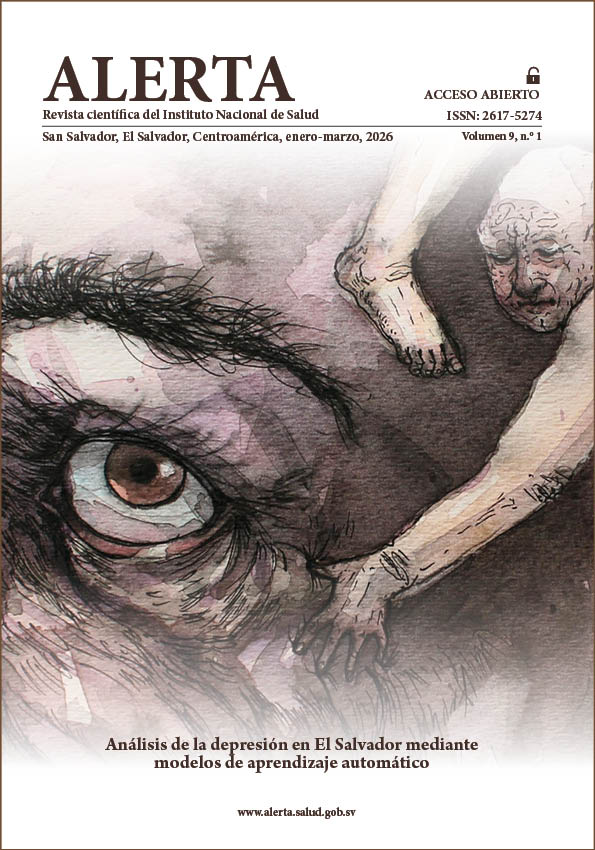
Analysis of depression in El Salvador using machine learning models
DOI:
https://doi.org/10.5377/alerta.v9i1.21956Keywords:
Artificial Intelligence, Machine Learning, Cluster Analysis, Risk Factors, Mental Health.Abstract
Introduction. Depression is a frequent mental disorder and one of the leading causes of disability worldwide. It has a multifactorial origin, resulting from the interaction between biological, psychological, social, and structural factors. Objective. Analyze the factors associated with depression in adults and older adults in El Salvador. Methodology. A crosssectional analytical study with a predictive approach was conducted on 7249 participants. A logistic regression model based on machine learning models was applied, trained on 80 % of the data and evaluated on 20 %, optimized through cross-validation and Monte Carlo simulations. The risk profile was categorized using clustering analysis. Results. Depression was associated with anxiety OR 10.385; (95% CI 8.760–12.310), post-traumatic stress disorder OR 4471 (IC 95 % 3257-6138), COVID-19-related stress OR 2.42; (95% CI 1.437–4.092), suicidal ideation OR 1.968; (95% CI 3.257– 6.13), recent discrimination OR 1.338; (95% CI 1.090–1.643), being female OR 1.291; (95% CI 1.072–1.55), unmet basic needs OR 1.192; (95% CI 1.0161.399), and functional disability OR 1.044; (95% CI 1.038–1.051), p < 0.05. The average AUC was 0.836. Clustering analysis identified three groups: high, medium, and low risk. The high-risk group had low social integration and high functional and emotional impairment. The departments of Morazán and Chalatenango had the highest proportion of high risk. Conclusion. Depression is influenced by a complex interaction of emotional, social, and structural factors, with a higher prevalence in women and differences in the geographical distribution of risk, which requires comprehensive and targeted interventions
Downloads
486
PDF 20
Downloads
Published
How to Cite
Issue
Section
License
Copyright (c) 2026 Xochitl Sandoval López, Karina V. Alam, Zaida I. Álvarez, David A. Tejada

This work is licensed under a Creative Commons Attribution 4.0 International License.
Privacy statement:
Alerta articles are published under license Creative Commons 4.0 CC BY: https://creativecommons.org/licenses/by/4.0/
Authorship rights
Revista Alerta gives the authors exclusive control of their work and the right to be acknowledged and cited.